Pages

Sunday, September 29, 2013

Evaluation of the NWEA MAP Test (in Ann Arbor)

Back in March of 2012 (around 18 months ago) my friend Julie and I went to the AAPS school board meeting to talk about our concerns about the NWEA MAP test. In 2011-2012, the MAP test was first used in the Ann Arbor schools, at the K-5 level throughout the district, and only for grades 6-8 at Ann Arbor Open and at Scarlett Middle School.

Before I get into talking about evaluation, it's worth noting that the Ann Arbor Chronicle has writeups of the initial discussions at the school board meetings in 2011, and you can find them here:

March 2011 Performance Committee discussions, as reported to the board

April 2011 Performance Committee discussions, as reported to the board

May 17th, 2011 report on board discussions (first briefing)

May 30th, 2011 report on board discussions (second briefing)

[Side note: Boy do I miss those Chronicle reports on the school board!]

By the time I realized what was going on in the school testing world, it was nearly a year after the school board had voted on getting the NWEA MAP test. And I felt that we had been sold a bill of goods. That's why Julie and I went and shared our concerns with the school board (links are on "Julie" and "I").

One of the main requests that I made was to have the use of the NWEA MAP test evaluated. I wrote:

5.     Since this is a pilot, do a rigorous evaluation of MAP’s usefulness. Evaluate whether the MAP test is working for everyone else. And do that by surveying principals, administrators, teachers, parents and students—anonymously—so that they can share their true opinions.
Shortly after that I met with Alesia Flye, Dawn Linden, and a woman from the technology department whose name I've forgotten. It's worth noting that none of them were at the Ann Arbor Public Schools when the decision was made to use the NWEA. I didn't keep good notes of the meeting, but I did leave with the impression that they would be evaluating the use of the MAP test.

Also around this same time, I met with several school board trustees at a technology bond meeting. I told them, I don't like the NWEA MAP test, I don't want my money going for technology that will support it. I was told by Deb Mexicotte (and again I didn't write this down) that she thought the MAP test would be around for at least 3 years, but it would be evaluated.

Meanwhile, my friend Angela also complained, and had a meeting with curricular staff.
In June of 2012, she had the following email exchange with Dawn Linden:

Angie to Dawn, 6/5/2012:
Thank you so much for taking the time to meet with Pam and I today.  I had no idea we would talk for so long, and still feel like there was still more to say.  I appreciate hearing your take on the NWEA tool.
On the drive home, however, one part of our conversation gave me pause.  You said that a parent and teacher feedback survey is in the works, as this is a pilot program.  You also mentioned that the NWEA is NOT going away.  What is the puprose of the survey, then?
Dawn to Angie, 6/5/2012:
Thank you, Angie.  I appreciated the meeting and welcome further discussion, too.  We've been seeking information from teachers and principals informally throughout the process.  That feedback has been overwhelmingly positive.  We do plan to share a brief survey with parents seeking information about parent understanding of the tool and its uses as well as how we can improve reports. I hope that helps to answer your question and please don't hesitate to call. (Emphasis added.)
Angie to Dawn, 6/8/2012:
So even though this test is in its pilot year, the district has all ready decided that implementation of it will continue as is. And this has happened before any feedback has fbeen collected from the test-givers, test-takers, tax payers, teachers, or AAPS families that are all supposed to benefit from it?
Dawn then offered to meet with Angie again.

This came from an October 2012 AAPS student achievement report. Does it add to
your insight as to how students are doing? Yup, that's what I thought too. Found at:
http://annarborchronicle.com/wp-content/uploads/2012/10/101012studentachreport.pdf
Understand, too, that as an Ann Arbor Open parent, I was and am extremely aggravated that Ann Arbor Open and Scarlett were (and still are) the only middle schools getting tested. If it's such a great test, shouldn't everyone else get a chance to take it? And if it's not such a great test, why should we suffer? Shouldn't that be evaluated?

But I'm patient. (No, not really. But I do believe that good evaluations take time. And so I waited.)

Meanwhile. . . the only change that the district made (that we could see) was that kindergartners didn't have to take the test until the winter. Instead, they got to take "practice" tests. (Are you aggravated yet?)

So in April 2013, Heather sent a FOIA to the district. Yup, that Heather. Here is what she sent, and what she got.


1. Any plan for evaluation of the NWEA MAP in the Ann Arbor schools, in final form
or if not finalized in draft form, with the date when the plan was developed. 
a. Currently there is not a formal written evaluation plan. 
2. Any discussion via email of plans for evaluating the NWEA MAP (for example,
between and among the Superintendent, her cabinet, other administrators (AAAA
group), the school board, and/or the technology department. 
a. No emails exist on this topic.
Now, we have a situation where there is no formal written evaluation, in draft or final form, and that is disappointing. But if no emails exist on this topic, then that is--in my opinion--inexcusable--because it means there is really no intent to evaluate, no discussion of the topic even. 

The school district is using a test that has evaluation in its name, to evaluate students--but we're not evaluating if it does a good job at that. The district is using a test that has evaluation in its name, to evaluate teachers--even though the organization that developed the test says it shouldn't be used that way. The district is using a test that takes a tremendous amount of staff time and technology time to use and administer, but we don't account for that time and effort to see if it is worth it. The district is using a test at two middle schools, and not evaluating whether it is worth extending or cancelling. We haven't been able to improve the reporting to parents in any way that would be meaningful. We have been told that the test would be evaluated, but it hasn't been. 

And that's why--if anyone asks me if they should opt their kids out of the NWEA MAP test--I do not discourage them at all.

So--that's the bad news.
The good news? There is a new superintendent in town, and maybe she is open to new ideas. It's worth a try. Let her know how you feel. There are a whole lot of community meetings coming up in the next two months!

Wednesday, September 25, 2013

Sunday, September 22, 2013

The (financial) costs of (NWEA) testing in Ann Arbor

Because I no longer have a child in K-8 grade, I missed the start of the NWEA MAP testing period. I only heard it had begun when I heard through the grapevine about a technology problem in the testing at Ann Arbor Open during the first week of the testing period.

You might recall that my friends and I have raised a lot of questions about the NWEA MAP testing over the past couple of years. You can read more about our concerns in some back posts:

Testing the Year Away: Julie's Comments

Testing the Year Away: Ruth's Comments

Ann Arbor: Stop Overtesting Our Kids! (the petition was submitted; the facebook group is still alive and well if you want to join us)

Real Life NWEA Experiences, Part I

Kindergarten Blues

Are You Following the NWEA MAP Controversy in Seattle?

Standardized Testing Season: Did You Want to Opt Out?

In any case--because of those concerns, we decided to FOIA some materials  from the Ann Arbor Public Schools around costs and evaluation. This post is only about costs.

Obviously, there are costs involved with testing--both direct and indirect. What are they? We asked "invoices, bills, or contracts" for 2011, 2012, and 2013, for the NWEA MAP test  (and no others, even though there are several others).

For 2011-2012, the bill was $96,401.50 (including $3,700 for an on-site administrative workshop)

For the 2012-2013 year, the bill was $77,701.50.

And on May 6, 2013, while we were still discussing the budget, AAPS got a bill from NWEA for $94,024 for the 2013-2014 year.

Picture of the 2013 NWEA MAP test invoice

[Here, by the way, is the "Master Subscription Agreement" if you are interested in knowing what AAPS has agreed to in the NWEA license agreement.]

In other words, over the past three years, we have spent more than a quarter of a million dollars ($268,127 if you are counting) on purchasing the licensing for the NWEA MAP test.

Now obviously, software doesn't install and manage itself; teachers don't learn to use the test by themselves. In fact, it turned out that our technology wasn't even adequate to properly run the test, and so the rationale for computer upgrades (and the cost) should appropriately be--at least partially--attributed to the use of the NWEA MAP test.

In a separate FOIA (one that was more focused on evaluation--coming next) we asked for information about some of the staff costs, and were told:

3. The amount of staff time from the curriculum and technology departments that has
been devoted to addressing implementation and deployment of the NWEA/MAP over
the past two years (fiscal 2011-2013)
 
a. This information is difficult to isolate given that NWEA MAP training has occurred in conjunction with other topics surrounding the use of data to differentiate instruction. There is no separate document that provides this information. 
4. The number of inservices given (total number of hours, along with dates) to teachers
and administrators, the number of hours spent on these inservices and the number of
teacher/administrators trained for the purposes of implementing the NWEA MAP
test. These inservice hours could, for example, relate to how to administer the MAP
test, how to understand MAP test results, and how to use that information to inform
teaching.
 
a. This information is difficult to isolate given the NWEA MAP training has occurred in conjunction with other topics surrounding the use of data to differentiate instruction. There is no separate record of NWEA MAP inservices or professional development.

Which means that I don't actually know the costs. But I am going to take some educated guesses as to the amount of staff time spent on the NWEA. These are rough estimates.

In Year 1, I am going to estimate that every K-5 teacher and all of the 6-8 teachers at Scarlett and Ann Arbor Open, spent at least 4 hours on inservices (trainings) related to the NWEA. With approximately 20 teachers at each school, and 20 elementary schools (so 400 teachers, PLUS another 40 middle school teachers), we get 440 x 4=1760 hours x $50/hour=$88,000.

Half of those teachers spent at least 5 hours preparing for and proctoring the MAP test (and yes, it was supposedly much less time than that, but I don't think it turned out that way). 220 x 5=1100 hours x $50/hour=$55,000.

In Year 1, I am going to estimate that at least one technology person spent hundreds of hours on dealing with technology issues around the MAP test (there were many), and that between the various curriculum staff, they also spent several hundred hours on the MAP test, troubleshooting, training teachers, etc. So if between them, they spent 750 hours on the MAP test (and I think that is low), that would be 750 x $50/hour=$37,500.

And then, of course, the technology we had was not adequate, and one of the rationales for the tech bond was that we needed to upgrade our computers for the MAP test. And that was really a lot of money.

I will mention, but not count the costs of, the additional sheets of paper that we parents got with (completely useless and unintelligible) test results--three times/year. But if there were 8,000 students involved, and therefore 8,000 pieces of paper each time, that is 24,000 sheets of paper (8,000 x 3) and the ink related to printing them.

I know, you are thinking, "But Ruth, we would be paying those teachers, tech people, curriculum staff anyway." Sure, that's true. "And we needed better computers anyway." OK, that might be true as well.

But those teachers, tech people, curriculum staff could be spending their time on other things if not for the MAP tests, so I think we have to ask if that time-money (over $180,000/year) was well-spent. Was that time-money well-spent?

Was that hard cash well-spent? Or could we find a different way to spend a quarter-million dollars a year? This is not just a thought experiment. It's a serious question. I know there are people who believe this is an important task. But let's admit that when we "estimate" the cost of the MAP test, it is not just the $75,000-$100,000/year. It's a lot more.


Tuesday, September 17, 2013

It's Constitution Day!

United States Post Office Department,
via Wikimedia Commons
Looking for resources on the Constitution, for today or the future?

Here is the ACLUs Constitution Day page. They've got lots of activities and ideas for teachers. I haven't really looked at it, so I don't know what is on it, but I'm sure at least some of it is worthwhile.

Tinker Tour USA is starting on Constitution Day. Some of you may know the Tinkerhess family from Ann Arbor (think 4th Ave. Birkenstock). Paul Tinkerhess's family was involved in a famous school free speech/peace protest that went all the way to the Supreme Court as Tinker v. Des Moines, 1969.

The Tinker Tour, a way of drawing attention to free speech issues, is starting at the Liberty Bell in Philadelphia, with Paul's sister Mary Beth Tinker and brother John Tinker.

You can follow along their tour here.

Monday, September 16, 2013

Standardized Testing Season: Did You Want to Opt Out?

It's standardized testing season and I have a whole lot to say about that (very little time, though!). But my friend Heather shared her "I am opting my child out of standardized testing" letter, and since you might want a sample letter, here it is. She says you can share it.

Dear _________ Public Schools, 
Last school year our family “opted out” or withdrew our child from some of the standardized assessments imposed on children across the state. Our decision to “opt out” in no way reflected on the teachers, administration, or school board. This was not an easy decision for us, but we feel that we had no other choice. We simply see these tests as harmful, expensive, and a waste of time and valuable resources.
This year we will continue our effort to eliminate unnecessary and harmful assessments in our public schools. Our child will not participate in any assessments other than those solely for the use of the individual classroom teacher. 
We refuse to allow any data to be used for purposes other than the individual teacher’s own formative or cumulative assessment. Any assessment whose data is used to determine school ranking, teacher effectiveness, state or federal longitudinal studies or any other purpose other than for the individual classroom teacher’s own use to improve his or her instruction will not be presented to our children. To be clear, our child will not participate in the following: 
• Any state assessments. 
• Any so-called “benchmark” exams whether they are teacher-designed or not, since these exams are imposed by entities other than the individual teacher. 
• Any surveys, or “field tests” given by corporate or government entities or testing companies  
• Any “standardized” test. 
We will be encouraging other parents to stand up against the testing fad and, more importantly, the corporate and government takeover of our schools. We believe in and trust our highly qualified and dedicated teachers and administrators. We believe that our child’s education should be trusted in the hands of those who are most experienced and who personally know the needs and individual requirements of each child. 
Teachers already know how to determine those needs and requirements without mandated standardized testing. Our schools will not suffer when these tests are finally gone. They will flourish.__________Public Schools should have a unified policy in place to address children who will be opting out of assessments. 
Thank you.

Friday, September 13, 2013

Math Lessons for Language People

One of the books I read over the summer was  When Languages Die: The Extinction of the World's Languages and the Erosion of Human Knowledge by K. David Harrison.  This book tackles the issue of languages with only a few speakers remaining, and asks--what do we lose when we lose these languages? Overall, I thought the book was interesting but uneven. At times the author tries too hard to prove that we lose a lot. (I sort of thought that was obvious, but maybe it's not.) There were two sections that I found very thought-provoking. One of those sections is very rich reading for math teachers.

Sign Languages

Harrison does have a fascinating discussion at the end of the variety of sign languages that are being lost. As he writes:

So far, there are 121 identified and named sign languages used in deaf communities around the world, but potentially a great many more remain completely undocumented. Many sign languages are now rapidly vanishing. This is in part because many deaf communities possessing unique sign languages are small, indigenous, and rural. . . Signed communication systems arise spontaneously wherever deaf people live. . . as soon as there is a community of deaf people. . . these systems develop into full-fledged languages, rapidly becoming as complex as spoken languages (pp. 230-231).
Numbers and Language

The other chapter of the book that really got me thinking was the chapter on numbering systems. Here, I believe there is an opportunity for some really great math lessons (Chapter 6, pp. 167-200--I'm only going to talk about bases here, but for math teachers there is some really great food for thought in this chapter about all kinds of math concepts).

I was a very good math student, but a better "English and other languages" student. And one part of math that I never fully understood (I got it, but I never really "got" it) has to do with counting in other bases. Yes, we learned to count in base 2, and base 5, and base 12. . . but the truth is that my mind was really "converting" from base 10 to the other bases.

From reading this book, I started understanding that languages embody their math bases, and that not every language uses base 10. Chapter 6, Endangered Number Systems, is all about this. In the Pomo language of California (which now has fewer than 60 speakers), the counting system is in base twenty. The number 20 is "1 stick," and 400 is "1 big stick."

Some languages count with body parts. Fingers and toes seem obvious, but other counting systems rely on arms, elbows, and even nostrils and collarbones. The Kewa people of Papua New Guinea count in base 4, using the hand as the basic unit--but they omit the thumb!

It goes on--there are many languages in Papua New Guinea, and among them the Aiome employ a base-2 counting system; the Loboda use both base-5 and base-20 systems; the Huli use a base-15 system; and the Bukiyip use base 3 and base 4.

Harrison notes that non-base-10 languages may have a cumbersome way to say a number that we think is important, like 1,000, but on the other hand, "non-decimal bases make it easy to say other numbers. In base-15 Huli, 225 is expressed simply as ngui ngui (15 x 15). Compare this to the relatively complex English expression 'two-hundred and twenty-five (2 x 100) + (2 x 10) +5. (p. 191)."

As I read this, it occurred to me that developing lesson plans that teach the way some other languages think about counting would be a natural way to teach about various math bases. For instance, could students design their own (non-base 10) counting system using body parts or other things that we find around us? Which

And at the same time, it would achieve one of my ulterior motives--to keep U.S. students from thinking that what we do in our country, and in English, is the only or best way to do things.*

*Fueled by a recent conversation I had with a graduate of a local high school who told me she never took any foreign language because "I'm American, and I live here, and we use English, and I don't need it--it's not important." 

Wednesday, September 11, 2013

Senate Teacher Evaluation Hearings: Watch Some Video

Steve Norton of Michigan Parents for Schools is sharing information about the Senate Hearings on the Teacher Evaluation report that I shared in July.

Deborah Ball is the Dean of the UM School of Education and she was chair of the committee that developed that report.

One of the main issues is whether standardized testing should be used to evaluate teachers--that is basically what is written into the legislation. I think it's referred to as VAM.

Steve writes:
Here's video, from Senate TV, of Deborah Ball's presentation on the teacher evaluation recommendations. It's long - 1.5 hours - but worth it, especially for the question and answer period. Share widely so that everyone has a chance to see what has been proposed and the kind of reception it's getting from our Legislature.
I think there is a way to fast forward if you just want to get to the Q & A.

The video (I can't figure out how to pull it in to the blog, although I'm sure there is a way):

http://vimeopro.com/mipfs/teacher-eval-hearings/video/74334074


Monday, September 9, 2013

School Security, Sinking Funds, & Sinking Hearts

Amy Biolchini reported on two important articles about school security in the past couple of weeks.

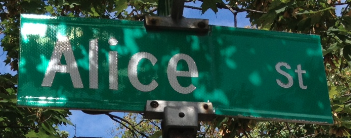
Yes, Alice Street is a small street on Ann Arbor's west side. 
No, it doesn't have anything to do with the ALICE program--
except that they share a name.
Photo by Ruth Kraut
In Article #1, Amy writes that Washtenaw County schools are giving teachers and other staff more flexibility in how to respond to outside threats from shooters or other assailants. This is called the ALICE program, which stands for Alert, Lockdown, Inform, Counter, Evaluate. This sounds like a great program and I'm glad that the schools are all on board for training on this program.

In Article #2 (which was actually published first), the school board discusses restricting access to schools in a major, major way--so that all doors will be locked to all schools during the school day. The cost--at this point--is estimated to be nearly $200,000 and to come out of the sinking fund.

According to the article:
This year, the district is planning to implement a new policy: Locking all exterior doors on school buildings during daytime hours. The implementation date has yet to be determined.
I don't believe the full board has voted on this. I got the impression from the article that they took a sense of the board but that voting on this will be on a future agenda.

But in order to lock all of the doors, they need to find a way to let people in. And therein lies the cost.

According to the article,
The district is considering several methods that would give certain individuals access to the building during school hours:

  • Using a keypad system in which parents and other qualified individuals get a code that will allow them access to a main door
  • Using a video surveillance and intercom buzzer system that only allows a staff member inside the building to admit someone in from the outside
What will this cost?
The estimated cost* to implement the new security measures is $190,000, which the district has allocated in its 2013-14 property upkeep budget funded by its sinking fund millage. The district also wants to replace all of its schools' exterior doors in the next five years should the sinking fund millage be renewed.
[*Slight digression: I'm not sure how we estimate the cost if we don't know what system we would use. My guess is that this estimate is quite low given the number of schools the district has.]

Do we need this system? Will it make our schools safer? 

I don't believe so.

As a parent, I think this is a terrible idea. It will overburden school office staff (who have already had additional duties added/cuts made over the past several years). It creates an impediment for parents coming into the building to volunteer or to pick up their children for doctor's appointments, for special presenters, for staff meetings.

And most importantly, those locked door policies give an illusion and false sense of security. In fact, in the Newtown, Connecticut shootings (referenced by Andy Thomas in the article), the schools had those locked door security measures. It didn't make a difference

[In the Columbine school shooting, there was an armed guard in the building. It also didn't make a difference.]


From CNNEarlier this year, the [ed. note: Newtown Sandy Hook elementary] school principal, Dawn Lafferty Hochsprung, ordered a new security system installed that required visitors to be visibly identified and buzzed in. As part of the security system, the school locked its doors each day at 9:30 a.m. The door was locked when the gunman arrived.

On December 19, 2012, after the Newtown Connecticut shooting, the Interdisciplinary Group on Preventing School and Community Violence, an impressive array of violence prevention researchers, including some who specialize in school security, put out a School Shooting Position Statement. They wrote:


"Inclinations to intensify security in schools should be reconsidered. We cannot and should not turn our schools into fortresses."
Right. I want our schools to be community centers.

Part of their statement reads:

Inclinations to intensify security in schools should be reconsidered. We cannot and should not turn our schools into fortresses. Effective prevention cannot wait until there is a gunman in a school parking lot. We need resources such as mental health supports and threat assessment teams in every school and community so that people can seek assistance when they recognize that someone is troubled and requires help. For communities, this speaks to a need for increased access to well integrated service structures across mental health, law enforcement, and related agencies. We must encourage people to seek help when they see that someone is embroiled in an intense, persistent conflict or is deeply
troubled. If we can recognize and ameliorate these kinds of situations, then we will be more able to prevent violence. These issues require attention at the school and community levels. We believe that research supports a thoughtful approach to safer schools, guided by four key elements: Balance, Communication, Connectedness, and Support, along with strengthened attention to mental health needs in the community, structured threat assessment approaches, revised policies on youth exposure to violent media, and increased efforts to limit inappropriate access to guns and especially, assault type weapons. 
The National Association of School Psychologists, in a 2013 position paper titled Research on School Security: The Impact of Security Measures on Students, writes:

The widespread public impression that schools are unsafe—fueled by rare, but highly visible school shootings—is contradicted by empirical evidence. (endnotes 22, 23) In fact, schools are not only safe, but are arguably safer today than they were a decade ago. (endnote 24)

Well, then, what would I suggest?

I am in favor of keeping most of the school's doors locked and directing access through the main door of each school. That makes sense to me. There will probably be some small cost in creating signs directing people to the main doors. And in some schools, you cannot see the door that is currently used as the main door from the main office. There probably should be some way to monitor those doors. At Ann Arbor Open, that involved adding another interior window to the Ann Arbor Open office.

And while we're discussing this, did you know. . . 

that although it is illegal to carry a concealed weapon into a school in Michigan, it is apparently legal to openly carry a weapon into a Michigan school? No, I'm not making that up. The father of a Clio-area child apparently did just that recently. Read more about the law and the "incident" here.


Other Good Ideas


The Interdisciplinary Group on Preventing School and Community Violence also wrote that:

Concerned students, parents, educators, and stakeholders in the community should attend to troubling behaviors that signal something is amiss. For example, if a person utters threats to engage in a violent act or displays a pronounced change of mood and related social behavior, or is engaged in a severe conflict with family members or coworkers, it makes sense to communicate concerns to others who might provide assistance. Early identification is important not only to prevent violence, but to provide troubled individuals the support, treatment, and help they need.
As far as I know, the only person who has been killed in a school in the last 30 (or more? maybe many more?) years in Washtenaw County was the Superintendent of the Chelsea Schools. A Chemistry teacher, Stephen Leith, who was being disciplined, left the school after a grievance hearing, and returned with a gun, killing Joseph Piasecki and injuring CHS principal Ronald Meade and English teacher Phil Jones (Managing Violence in the Workplace, Capozzoli and McVey, pp. 9-13). In hindsight--and I know, hindsight is perfect--the strategy suggested immediately above by the Interdisciplinary Group (a communications strategy) might have helped. Locked doors with key cards would have done nothing.


So, About That Sinking Fund Money...


Please don't spend our hard-earned sinking fund monies on this, because then it makes me feel like I shouldn't support the next round of the sinking fund millage. There is plenty of other important stuff to spend those funds on, and I want to vote for the next sinking fund millage, but if the school board votes to use this money on such a poorly-thought out idea, I am not sure I can do it.

And I will reiterate what I wrote above: locked door policies as proposed above have not been shown to be protective, and they are a waste of our money.


Sunday, September 8, 2013

New K-12 Education Reporter

I started a post on school security (coming soon to a blog near you!) about a week ago, with these words:

"First of all, welcome to new annarbor.com K-12 education reporter Amy Biolchini. Amy is not a new annarbor.com reporter, but she is new to the K-12 education beat."

Already you probably see the problem.

I started writing this a couple of weeks ago--when we were still expecting there to be an annarbor.com. And now there will only be mlive.com. I think Amy will continue to be the K-12 education reporter for Washtenaw County. 

I see Advance Publication's move as a cost-cutting measure that will mean less news in Ann Arbor--and already, there was a lot less than there was ten years ago! In short, I'm bummed. Sigh. I am, actually, happy to see the name annarbor.com gone--I always thought it was a dumb name and then when people would try and write it as Ann Arbor.com, with the space between Ann and Arbor but still with .com--well--even dumber. But whatever mlive wants to call their local print product, to me it will not be the Ann Arbor News. 

As for the reporting, the truth would be to call it uneven. Some of it has been excellent, some of it terrible. The copy editing has been awful. The main problem of the writers, in my opinion, is that there are too few of them and also too few editors. I don't expect that problem to be solved by going to mlive.

And now--whoopee--we get to be experimented on once again.

If you are interested, Mark Maynard has some more comprehensive thoughtsSo does Ben Connor Barrie at Damn Arbor.  

Please, would somebody with lots of money like to buy the Ann Arbor News from Advance, the way the Boston Globe and Washington Post have been sold?

Saturday, September 7, 2013

Ann Arbor's "Exceptional Schools" Campaign

This is the post where I come clean about something I've been repressing.

I cannot stand the Ann Arbor Public Schools "Exceptional" motto or advertising campaign.

Don't get me wrong, I think our schools vary from good to excellent. But exceptional? Come on.


I don't know who came up with the slogan (it has been around a long time), but I have never liked it. The new superintendent seems to be dragging the slogan into everything (it was in her 90-day plan, and in her opening day speech...) and I hope that stops!

Actually, I'd love a contest for a new slogan. Got any ideas?


Wednesday, September 4, 2013

The Three Star Holiday: Ann Arbor Guidelines

"The three star holiday," someone wrote me. "Is that really a thing?"

Why yes, yes it is. At least in Ann Arbor.

In Ann Arbor, many years ago (and when I say "many years ago" what I really mean is, "before I had kids in the schools"--I don't really know when this was devised)--the school district came up with the idea of identifying religious holidays (even some obscure ones--or they might be obscure to you--as one, two, or three star holidays). The three star holidays are a combination of most important/most popularly observed for various religions.

Overall, I think the policy is well-written and designed. Where the district has fallen short (or rather some teachers/principals/coaches have fallen short) is in not following the policy.

Which is why, if you have children in the Ann Arbor Public Schools, and especially if you are a member of a minority religion/culture (Muslim, Jewish, Hindi, Greek Orthodox, etc.) I highly recommend that you read the policy. Knowledge is power! Then if there is a problem, you know how to complain advocate. . .

Read the policy here, but below I'm going to paste in the policy for three-star holidays in particular.

Real Life Experience

The Jewish calendar is a combined lunar/solar calendar, which means that there are leap months every two-three years that reset the calendar (so that a fall holiday stays as a fall holiday and doesn't move into a different season). And so Jews are often saying that "the holidays" are early or late. In the fall there are a series of important Jewish holidays--essentially, a month full of holy days.

In Jewish parlance, this year the holidays are "early." In fact, they are very early. They are so early that for the first time since Thanksgiving has existed, the first day of Chanukah is on Thanksgiving! (Yes, by the time Christmas comes we Jews will be done with all that candle lighting, gift-giving and potato-pancake-eating.)

Anyway, I've set this to post on Wednesday, the eve of the Jewish New Year (Rosh HaShanah), and the start of the "High Holy Days" season. For the next two days we'll be celebrating the new year with family, friends, and services. My son will not be in school, even though we will only be on the third and fourth day of the school year. When the three-star holiday policy works, it works very well. When it isn't followed, I can say from personal experience that it is extremely stressful.* (*=Story below the 3-star policy.)

Here is an excerpt from the policy:

RELIGIOUS HOLIDAYS GUIDELINESI. Holiday observances of major significance to a religious group are indicated on the calendar by three stars (***). The following apply:
School district employees may not schedule any of the following during these (three star) holidays.
   1. Major exams   2. Reviews for major exams   3. Standardized tests   4. Tryouts; for example, teams, plays   5. One-time or major events (proms, graduation ceremonies, homecoming, elections, test simulations, etc.)   6. School district employees shall schedule interscholastic athletic games in a manner that minimizes conflict with holidays designated as three star. Scheduling of an athletic event on a three star holiday must be reviewed by the Superintendent or designee. Board members will be notified well in advance when there is a conflict.   7. Interscholastic athletic practices are allowed
School district employees may arrange for students to participate in one-time or major events on three star holidays if the scheduling of these events is not controlled by our employees. Scheduling of such events must be approved by the building principal and the Superintendent or designee.
Teachers should be sensitive to the scheduling of quizzes longer than ten minutes on holidays designated by three stars (***).
Students will probably be with their families or at a place of worship in observance of these holidays. They will not be in school and/or not have time available to do the required homework. Absence to observe these holidays should be excused, and make-up privileges should be the same as the make-up privileges offered to a student who has an excused absence due to illness.

*Probably the area in which I have seen the most problems is athletics. Take, for example, the year that my son was playing Pioneer baseball, and a game was scheduled for the night of the first seder of Passover. (Jewish holidays start the evening before the day.) The game was not some outside competition. The game was not some league championship. The game was scheduled between Pioneer and Huron--clearly within the district's control, and violating point #6 above. My son (the only Jewish kid on the team) did not want me to rock the boat. He said, "I will just miss it, don't say anything." Apparently, at the last minute, a parent on the Huron team complained. As a result, the freshman game was cancelled--but not the JV/Varsity games. [This was before Skyline existed, and there was a freshman team.]

By far, the most common complaints I have heard about are athletic in nature. Coaches and Athletic Directors--put those religious holidays on your calendar and schedule around them! The second most common complaint? Science labs being scheduled, and then teachers being resistant to letting kids make them up. Reminder: the absence is to be treated in the same way as if a student was out for an illness.

Last year, the NWEA MAP test was given on Yom Kippur. Pat Green tried to argue that it wasn't a standardized test. (See #3 above.) Yes, it is a standardized test. Even if you think it isn't a standardized test, it certainly takes more than 10 minutes to give ! (See the additional guidance above.) My son ended up being pulled out of another class to take this completely unnecessary standardized test. Had I known about that in advance, I would have made a big stink. I didn't know about it in advance, so I couldn't. (This year, Yom Kippur is on a Saturday, but I hope Jeanice Swift will be more sensitive to holiday issues.)

** Another confusing piece of the holiday has to do with which holidays are two-star and three-star. There are Jewish holidays that get counted as "two star" even though according to Jewish law they should be treated exactly the same as some of the "three star" holidays. The reason, per the policy? "A balance between the formal religious standard and the actual contemporary observance of the holiday has been the intended aim of these recommendations." In reality, many fewer people observe these "two-star" holidays to the full extent of (Jewish) law. However, if you are one of those people, know that the two-star policy should protect your student: "Make-up privileges should be the same as those offered for an absence due to illness."

And although my examples of this have all been about Jewish observance, note that the guidelines are the same for the three-star Eid Al-Adha (this year, mid-October) and the three-star Epiphany (the first week in January, right when school starts back up). For those of you who are from other religions, think of these holidays as just as important as Christmas is in the main Christian calendar.

And in my opinion, if you (as a parent) feel that a holiday is important for you, then you should definitely keep your child out of school and let the school know why. The schools are trying to accommodate us, and when we let them know that we are observing a holiday, we give them a reason to continue to try to do so.

And with that, I will wish you a 

Happy and Healthy (Jewish) New Year and a 

Happy and Healthy New School Year! 

Tuesday, September 3, 2013

First Day of High School!

Today is the first day of high school for my son, and the first day of high school in the United States for our exchange student. For those of you with kids in school, or those of you who are teachers, have a great year!

Here is a special shout out to the new Ypsilanti Community Schools district--good luck!

 Part of a mural on the fence at Community High School. Mural by CHS and Angell students. 

Saturday, August 31, 2013

Labor Day: Poem and Dedication

Happy Labor Day!

This post is dedicated to the teachers and other staff of the new Ypsilanti Community Schools. I hope they have union contracts soon!

This post is also dedicated to the memory of the wonderful Irish poet Seamus Heaney, who understood the many ways that people work. He passed away earlier this week. Here are two obituaries, the first from BBC News, the second from the New York Times. (Want to read more about the "Troubles" in Ireland? Start with the BBC News obituary.)

So for your reading pleasure today, I've got a poem, Digging by Seamus Heaney. [It is from his first book, Death of a Naturalist (1966)]. I've got a few lines of the poem below, but to read the entire poem, and for the pleasure of listening to the poem, please click on the link.

Digging
Seamus Heaney

Between my finger and my thumb   
The squat pen rests; snug as a gun.

Under my window, a clean rasping sound   
When the spade sinks into gravelly ground:   
My father, digging. I look down

Till his straining rump among the flowerbeds   
Bends low, comes up twenty years away   
Stooping in rhythm through potato drills   
Where he was digging.


Alternatively, watch Seamus Heaney read the poem here (this is a montage the BBC News put together):

Thursday, August 22, 2013

The Hikone Exchange & My Blog Post Exchange: They're About Developing Relationships

Back in June, when I was doing the post-a-day blog-a-thon, I arranged to exchange blog posts with a former Ann Arborite, Joan Lambert Bailey, currently living in Japan. Joan wrote about language learning as an adult--specifically, her efforts to learn Japanese! You can read that post here. (I asked her to write about this because I am personally very interested in language learning.) Joan's blog is Japan Farmer Markets.

Meanwhile, I offered to write about Ann Arbor's educational exchange with Hikone, Japan. Hikone is in Shiga Prefecture and it turns out there are several other exchanges with Shiga Prefecture that are still going on.


In any case, my guest post on Joan's blog is titled

44 Years as Sister Cities: Ann Arbor, Michigan and Hikone, Shiga Prefecture


I start the blog post like this: 

In November 1968, the State of Michigan and Shiga Prefecture in Japan became sister provinces.

A few months after that, in February 1969, Ann Arbor Michigan invited Hikone Japan to be a “Sister City.” At the time, Ann Arbor already had sister city relationships with Tuebingen, Germany and Belize City in Belize. Ann Arbor has the University of Michigan, and Tuebingen and Hikone both have universities.

In fact, the first article about Hikone in the Ann Arbor News from February 9, 1969, starts out:

“Watch out for the monkeys,” signs warn drivers near Hikone, Ann Arbor’s new sister city in Japan. Michiganians traveling in their sister state, Shiga Prefecture, may be reminded of the “watch out for deer” signs back home.


And I didn't mention this on Joan's blog, but I got a lot of the information for this post from the Ann Arbor District Library's Old News feature, which you can find here. There are lots of great articles there!

The Ann Arbor Public Schools exchange program is coordinated by AAPS Rec & Ed.

Oh, and one more thing: Next time you drive down Packard Road and you see the street labeled Hikone, recognize that that street is named after Hikone, Japan--even though in Ann Arbor we pronounce the street Hi-Kone, and in Japan, they pronounce the city Hee-Koh-Nee! 

Monday, August 19, 2013

Welcome Dr. Jeanice Swift! Here is Some Advice

Dear Dr. Jeanice Swift,

Welcome to Ann Arbor! As I mentioned in an earlier post, I hope that you will sit down with Steve Norton of Michigan Parents for Schools, and John Austin, of the State Board of Education, to learn about Michigan politics around education, and what the legislature has done and is planning on doing.

But other people have some other advice for your orientation. Here it is (and I will also send it to you when I know your email address...)

I am a. . . Dear Jeanice Swift,
Parent, Community MemberDon't read AnnArbor.com comments, they don't represent the community or its opinions. It's like a car wreck that you can't look away from. That goes for anyone moving to our community, but especially for a public figure like a superintendent - the comments will be nasty and stupid and hurtful and occupy space in your head that they don't merit.
ParentFrom the students they are her main stakeholders
TeacherFrom a teacher's perspective, I want to know that you know what it means to be a teacher in AAPS. I'd love for you to come to some buildings and drop-in to classrooms (unannounced). You'd get an authentic sense of what's happening in schools and classrooms. While you are going to be very, very busy, taking the time to be visible, personable, and present is going to have a big impact on this community. Our perception of you plays an important role.

I also think that it's critical that you understand where AAPS and The State of Michigan are at financially. With Proposal A and the continued cuts to per-pupil spending, I hope that you will join in the political battle as other Michigan superintendents have. If Ann Arbor intends to pass any more millages (which we will need to do to even maintain some of the funding we already have), the community and public must fully understand why we (as a former hold-harmless district) need their financial support. The for profits have moved in (billboards for k12.com are everywhere in Michigan now) and AAPS needs to inform the public as to why we are still a great district and how much better we could be if properly funded.
ParentTalk to teachers and parents, but not just the ones that are angry about things and come pounding down your door. Go talk to the parents that are running different activities for kids, like Science Olympiad or other PTO things. Just because we aren't screaming mad about something doesn't mean we don't have ideas or suggestions.
ParentAvoid the polite "welcome reception" circuit, and instead devote time to:
1- attend 3 back-to-school (or "curriculum") nights (one elem, one middle, one high school)--not to be a speaker, but to hang out in the cafeteria or commons & hear what parents have to say about the school.
2 - select 3 different schools (one elementary, one middle, one high) and spend a half-day with the principal, including morning arrival and lunch.
3-attend 2+ after-school or evening games/events at the other high schools & middle schools, talking with parents and kidsJust hear what people are saying.
ParentGo to the schools and talk with teachers, parents, and staff to get their thoughts on what is going right and what is not going so well in the school. Not everyone will agree but there is often consensus on the big issues.
ParentI know Ruth already said this, but I want to second the recommendation that you speak to Steve Norton. He is an AMAZING parent advocate with a fantastic lobbying presence and website -- Michigan Parents for Schools.

I encourage you to get to know the character of all the individual schools in the district. It would be great if we parents had some way to tell you what we love, and what we don't love or wish for, in our schools. You would learn so much from this! Maybe it could be done with a straight-forward form like this one.

And we welcome you in your visits to all the buildings. You will get a good feeling for the schools when you visit each of them.
ParentWelcome! To learn about Ann Arbor and AAPS, I recommend:
1) Be present in the community and in the schools
2) Sit down with Steve Norton and John Austin
3) Sit down with Ruth
4) Have some sort of mechanism for community involvement. Ann Arbor is full of talented people, yet we have trouble matching the talent with the need in the schools.
5) Enjoy - Ann Arbor is a great city. We have great students and incredible teachers!
6) talk to the teachers
ParentI'd advise her to read through annarbor.com and Ann Arbor News coverage of local education issues (BOE elections and meetings, community budget forums, the millage votes, etc.) for the past 5 years (at least). It would be great if someone would volunteer to pull a comprehensive set of articles for her so that she doesn't have to use her time searching for them and figuring out which ones she can skip as insufficiently significant. I do think she should skim the annarbor.com comments, but take them with a grain of salt - i.e., I don't think they are usually representative of the community at large, but they do provide a good sense of what part of the community thinks. And there are at least a few commenters who express thoughtful views from across the ideological spectrum in a polite way.
ParentVisiting the schools, talking to the principals, teachers and parents. Getting input from all members of the Community.
ParentVisit the schools and tour the classrooms - seethe special education teachers in process; witness the Autism classrooms flowing with structure and compassion, meet the families that rely on transportation and free education; stroll the halls of all the middle schools to get a feel of the diversity of needs within each school; schedule meet and greets with parents (as a special ed mama with an autistic son in the AAPS preschool, and speaking on behalf of many other parents - we LOVE to meet with administrators and chat, just to cycle information both ways. Currently our principal Michelle Pogliano has not held up her agreement to meet with us regularly and it has hit morale HARD within the parent sector. Please visit our schools and meet your parents!).
Parent, Community Member, parent of kids in special edPlease visit lots of classrooms to see classes in action -- including regular classrooms of all ages, but also special ed, the preschool, Pioneer's theater program -- really seek out a variety of what's unusual to get a clear idea of the variety of what's out there, and what's working and what's not.

Also, please talk to lots of people, especially teachers and principals, to find out from them what they need, what's working, and what's not.

Thanks for reading this comment. I love that you started with an interview with annarbor.com and hope that you will continue to foster a culture of openness.
Parent, Community Member, Maria E. HuffmanI would advise her to meet people face to face.
Maria Huffman
ParentWelcome to Ann Arbor.

As a parent, I recommend that the new superintendent take two kinds of tours of the district.

First, she should try to walk through every building and jot down her impressions. I advise that she visit the elementary schools and then the middle and then the high schools to compare just the facilities at each level.

Second, she should try to "virtually" enroll.
Again, taking the perspective of an elementary parent, then a middle school parent and finally a high school parent. Enrollment options are numerous - especially if you don't want to only use the neighborhood school.

Best of luck
Marcia
Parent, Community MemberHow about community meetings - visiting local school PTOs or holding a couple of "town hall" type events where she can hear directly from parents and teachers? Obviously Dr. Swift will need a few good history lessons from those who are knowledgeable about education politics and legislation, as well as information from trusted sources within AAPS...but the best way to establish a real relationship with the community is to MEET with the community. She could present her vision for AAPS, establish her priorities, and get direct feedback from her real "customers".
ParentAttend a different PTO meeting every month to learn about what issues different schools are facing.
Hold a meet & greet at the downtown library; run it like a comprehensive planning visioning session where stakeholders can come and talk about their priorities, and where those priorities get synthesized into some actionable items.


AddThis