Pages

Showing posts with label history. Show all posts

Tuesday, March 8, 2016

Election Day: My High School's Polling Place

Here in Ann Arbor, we have the relatively simple and yet apparently not too likely to be tampered with paper ballots. They are easy to fill out, keep the lines moving, and there is a paper record if there ever needs to be a recount. Filling in the little circles today did kind of remind me of standardized testing, but that's not my complaint.

I went to a high school where the middle school was attached, and there was a polling place in a quiet corner of the high school. Of course (or maybe not of course--does it happen today?) visiting the polling place was definitely part of the grade 7-12 social studies curriculum.

Plus, if I would go with my parents, when I was little, to vote--there was a certain magic of going behind the private curtain (was it velvet? I think it might have been), pulling the private levers, and when you walked out of the booth, nobody knew who you were voting for.

And I know, rationally, that the system we have in Ann Arbor is much more secure than those old voting machines.

And I know, rationally, that these little booths are much easier for the clerks to move around from precinct to precinct.

And I know, rationally, that it is much easier to expand the number of booths in high volume elections.

But.

When I was a kid, those voting booths were magical, and even today, I miss them.

By Pauljoffe at en.wikipedia, CC BY-SA 3.0,
https://commons.wikimedia.org/w/index.php?curid=12796219


Consider subscribing to Ann Arbor Schools Musings by Email!

Sunday, February 28, 2016

Ypsilanti History: The Desegregation of Ypsilanti Schools

While it's still Black History Month I thought I would feature this interesting blog (and history of Ypsilanti schools) that I recently stumbled upon.

The information here comes from a blog about South Adams Street at the turn of the twentieth century. As the blog notes, "South Adams Street @ 1900 was created by Matthew Siegfried as a Masters project of Eastern Michigan University's Historic Preservation Program. Readers are encouraged to write with any questions or additions. Walking tours and presentations are available.
Email: southadams1900@gmail.com."
A special shout-out goes to the Ypsilanti Historical Society Archives, which provided a lot of the information Matthew Siegfried used. They welcome visitors, and I've done some research in them (particularly around Begole School). The archives have lots of great information. Find out more about them here
Today's topic is the First Ward School, and the full web site about it can be found here. [The author of the web site, Matthew Siegfried, has written about a lot more than just the First Ward School.]

The old First Ward School, on Adams Street, was built during the Civil War specifically for the purpose of educating black children. 

On September 10, 1897, the Ann Arbor Argus reported that "Ypsilanti has 1778 children of school age of which 155 are colored, a gain of three colored children and 10 white over last year."


Recorder, August 1916.
Photo by Matthew Siegfried.
Used under a Creative
Commons license.
As Siegfried characterizes it, "What began as a statement of support for black residents during the Civil War" became a symbol of segregation by the early 1900s, exclusively educating black students through sixth grade.

The school was not in good condition and things came to a head in 1916, when the black residents of Ypsilanti petitioned the prosecuting attorney, as taxpayers, for better schools. They objected to paying for the new Ypsilanti high school when their school was in such poor condition. 

The petition began:
We, the undersigned colored citizens of the city of Ypsilanti, residing in the First ward of said city, hereby petition you as an officer of the county to investigate the action of the school board of the city of Ypsilanti. We are paying a large tax for the building of a new school house. It is used for white to the exclusion of colored children. Our school, a ward school in the First ward, has no connection with the sewer, it is unsanitary and not healthful, but we are compelled, because we are colored and the board of education is white, to put up with whatever they hand us.
The school house is not sufficient or satisfactory. Do we get new? No, simply get an old discarded and poor building moved from another part of the city and placed out in the dusty street, or nearly so. It is within five feet of the street line, and thus cuts off our view down the street. Part of the time we have had undesirable teachers, part of that time poorly qualified, but we have to take it. 

Notes Siegfried, 


A bond was proposed by the [sic--but I think it was proposed by the school board and] voted down, with support of the black community, that would have rehabilitated the school while increasing the grades taught, effectively expanding segregation under the guise of aiding the school. The community was adamant; it wanted an end to segregation... Detroit attorney and NAACP leader Charles Mahoney, who later worked on the Ossian Sweet Case, led the legal challenge. The bond initiative was also opposed at the ballot box and defeated. The case was won in Judge Sample’s Circuit Court and Ypsilanti schools were formally desegregated in May, 1919. The First Ward school closed that year. 

The 1919 American School Board Journal explained things like this: 

The important question, in the court’s judgment, was whether the school was being conducted by the board for the children of negro parents of the ward In such a way as to compel the children, because they are colored, to attend the school, and at the same time to permit white children of the district to attend outside schools.The court maintained that the maintenance of the school was an act of discrimination against the colored children and that in view of the provisions of the Michigan law, it was a violation of the common law of the state and of the statutes of the state. The court cited a number of important decisions from Supreme Court cases to support its contention that all residents of a state have an equal right to attend any school and that they may not be discriminated against because of race or color.
The building is now the New Jerusalem Church.

Here are some more newspaper articles from the South Adams Street 1900 web site. 

Three additional notes:

1. Nearly one hundred years later, Ypsilanti Community Schools is a majority African-American district. Four years ago, I wrote: "It is important to remember that school segregation--though banished by law--still exists in many many schools around the nation." I wouldn't exactly call YCS a segregated district, but there are plenty of people who live in the district who send their children to schools--public, charter, or private--in other districts--and many of those families are white.

2. The First Ward School was referred to as the Adams Street School. This is not to be confused with the current Adams Elementary--which was originally named Prospect School. It was renamed in 1963 after Olive M. Adams, who was retiring from the school after being principal there for 29 years.

3. I knew about efforts to desegregate the Ann Arbor schools--in fact I've written extensively about them--but I never heard of this really significant (and successful!) lawsuit in Ypsilanti.

[And that, by the way, is in my opinion a signature of Ypsilanti--there's lots of super-interesting history, stores, museums, and parks in Ypsi--and unless you look closely, you might miss them.] For instance, do you know where this statue of  Harriet Tubman can be found? 
Sculpture by Jane DeDecker,
photograph by Dwight Burdette
[CC BY 3.0 (http://creativecommons.org/licenses/by/3.0)],
via Wikimedia Commons


Consider subscribing to Ann Arbor Schools Musings by Email o

Sunday, July 5, 2015

Guest Post: This is How Our Public Schools Die

Occasionally someone volunteers to write a guest post! I think this post, by Steve Norton, the Executive Director of Michigan Parents for Schools (written in his capacity as a parent, but with the knowledge he brings from MIPFS), is worth your time! He calls it a "companion piece" to the parent letter that was sent to the Ann Arbor school board and teachers' union. (See this post.)

The little embedded video--all of 11 seconds long--is from the movie Independence Day--a movie I've never seen. This holiday should remind us all of our rights and responsibilities as Americans, and that's really what Steve's post is about! (And that's why I've got the text colors set up in red and blue!) --Ruth


By Steve Norton


Everyone who cares about education in our community ought to be paying attention to what is happening right now between the leaders of our school district and the union which represents Ann Arbor teachers. Not to take sides, or to point fingers, but to understand the awful consequences of policies crafted over many years by "think tanks" and lobbying groups who hold tremendous power in Lansing. What we are seeing here today was scripted long ago, by those who hold community governance of education in contempt. Should we continue to follow their script, or should we start writing our own?

As a concerned parent, I definitely want a strong and stable school district which can offer great programs, maintain reasonable class sizes, and avoid constant crises. But as an involved parent, I also know that what matters most for my children is their everyday interaction with the teachers and other professionals who educate and care for them. School is not a place where we send our children to download "facts" and memorize algorithms. A quality education helps teach our children how to think, how to ask the right questions, and how to understand those different from themselves. Together, parents and schools prepare our children to grow into thoughtful citizens and productive members of our community. That's not something which can happen without talented, committed professionals at every level, most especially in the classroom.

So what has our state done to help make this possible? More than twenty years ago, we placed the fate of our local schools largely in the hands of the state legislature, because we gave them control over the funding for our schools. Money isn't everything, but schools are dark and cold without electricity and gas, buses don't run without fuel, and programs don't exist without the people to implement them.

Since that time, districts like Ann Arbor have seen their per-pupil funding lag behind inflation nearly every year, to the point where the real spending power of our funding is  over 21% below where it was in 1995, even before retirement costs are subtracted. Overall state spending on K-12 education has stagnated over the last decade and more, and when the mandatory payments to the state retirement system are taken out, real state per-pupil spending is down 21% since 2002. Perhaps more important, the share of our state's economic product that we use to pay for education has gone steadily down over the last decade: in good times or bad, we are committing less and less of our income to support K-12 schools.

In response, local school districts have been cutting programs, laying off teachers, insisting on pay concessions from employees, and privatizing any services which can legally be contracted out. Class sizes have risen, offerings have narrowed, and teachers have not only had their pay cut but their resources slashed. The rise of high-stakes testing has pushed quality education aside for the sake of test prep. The system, and everyone it it, has been under more and more stress as the years pass by. For background on how this has played out in Ann Arbor, please see the presentation here: https://drive.google.com/file/d/0B3W0G8KNKLfLempCX1BoUTJVMUU/view?usp=sharing

Make no mistake: this was intentional. Having restricted itself to a funding bucket that was no longer adequate for our schools, our Legislature alternated between years when they pompously announced that we "need to live within our resources" and others where they patted themselves on the back for increases which were really illusions. But the consequences of these choices, and the pain, played out at the local rather than state level as school boards were forced to oversee the dismantling of their local schools.

To add fuel to the fire, our elected state officials passed laws to ensure greater conflict at the local level. Starting in 2011, the Legislature made topics which had traditionally been worked out between teachers and school boards into "prohibited subjects" that could not be subject to bargaining and instead are under the sole control of the school board. Sensitive matters to teachers, such as staffing and placement, evaluation, layoff and rehiring priority, and the minimum standards for firing, were handed to beleaguered school boards as a replacement for adequate funding. "You won't get any more funding, but you can use these as leverage to whip things into shape." Already backed into a corner, is it any wonder that school boards were willing to use those new powers?

Furthermore, faced with constant pressure for financial concessions, rising health insurance and retirement costs, and now a real threat to their working conditions, is it any wonder that many teachers and their unions chose to fight back?

But why set this in motion? Well, if you believe - as many influentials in Lansing currently do - that "government" can never to anything as well as the private sector, and that it should be as small as possible, you want "public" education to be placed into private hands. The easiest way to do this is to get families to vote with their feet, and abandon local public schools rather than try to save them. The money follows the children - all of it. After all, who wants to stay on a sinking ship?

It is not necessary to get into the details of what has happened in Ann Arbor to recognize the pattern (for more, see the Parent Letter here [http://a2schoolsmuse.blogspot.com/2015/07/parents-ask-aaps-board-teachers-union.html]). We are being forced to fight over a shrinking pie. As the pressure continues, and the fights accumulate, our local public schools will be undermined, public confidence in them eroded, and talented educators driven away. This is how our community-governed public schools will die.

When you are in the middle of the fight, it can be hard to step back and look at the big picture. But for our community, it is essential. These kinds of battles will lead nowhere good - and the people who set the stage for this struggle know that. It's time we took it to heart ourselves.

Our school leaders and educators need to set aside their legal weaponry, and quite literally beat their swords into plowshares. All the resources being used to further this standoff, the legal and organizational effort involved, would be better used to secure a settlement among stakeholders locally and to find allies across the state for political action. Those of us on the outside, parents and members of the community, have a job to do as well: we need to do what we can to plug the financial holes for now, and add our energies to the effort to force our lawmakers to do right by our children and our schools. It may seem trite to say "Fight Lansing," but if we do not, our future is clear - and it will play out just as they intended.


Consider subscribing to Ann Arbor Schools Musings by Email!

Wednesday, May 6, 2015

When the Custodians Were Cut, Where Were We?

Those of you who know me outside of my blog may have heard that my daughter Lior, a sophomore at Tufts University in Boston, is the president of the Tufts Labor Coalition. The Tufts Labor Coalition (TLC) has spent most of this year working on the unionization of adjunct faculty, and the preservation of custodial positions as the University switches contractors and decides to have fewer custodians (approximately 1 in 6 custodians' jobs would be cut) to cover an expanding number of university buildings.

TLC has been working with the custodians' union, the SEIU. In the past week TLC and the SEIU held a rally and a protest where several students were (intentionally) arrested in an act of civil disobedience. This week, students are hunger striking. I'm not a big fan of hunger strikes, but there have been articles in the Boston Globe, New York Times, In These Times, television, radio programs like Democracy Now, Huffington Post, and more.

[You can follow them on twitter @tuftslabor or on Facebook at the Tufts Labor Coalition page.]

Lior is on the administrative liaison team. Here she is (bottom right)
going in to meet with the administration. Note the banner the students
have hung at the top of the stairs. Photo from @tuftslabor.


I like this picture, because it names how many families
and lives will be affected. Photo from @tuftslabor. 


All of which brings me back to what I was thinking.
Last year at this time, the Ann Arbor school district was outsourcing and eliminating custodians' jobs.
[Read: Here and here.]

Where were we?

When my older son was in second grade, he and his friend decided to have a contest to see who could drink the most water. Not surprisingly, they drank a little too much, with predictable results. The custodian cleaned up their vomit--and though we made them apologize to the custodian then, I don't really think that's the thanks, or the apology, the custodians needed.

Where were we, parents?
Where were we, teachers?
Where were we, students?
Where were we, principals & secretaries?

Where were we, citizens?

And this plagues me now, as I have heard recently that several custodians are dealing with foreclosures and evictions.

Why is it that a relatively small group of students at Tufts can make a big deal about 35 lives, and we couldn't even lift a finger?


OK...I did lift a finger. Ten, actually, but only on my keyboard.

June 2014 story

April 2010 story


Consider subscribing to Ann Arbor Schools Musings by Email!

Wednesday, April 22, 2015

Discovering (and Remembering) My First Grade Teacher, Mrs. Delfosse

My first grade teacher, Doris Delfosse, died recently. My mom sent me her obituary. (Thanks Mom!)

There were some things in it that I knew about her.

I knew that she was a devoted and well-loved first grade teacher.
I didn't know that she taught for over 35 years.
I didn't know that she was the president of the Rye Teachers Association.

I have a vague memory of doing grave rubbings with her.
I didn't know she did that as part of a big Thanksgiving-focused unit. Every year.

We lived in one of the first towns settled on the east coast (1660).
It has the Square House, which at one point was the local inn, and "George Washington and Lafayette slept there!"
I didn't know that Doris Delfosse was a member of the Daughters of the American Revolution, or that she volunteered to share American history and early American homemaking skills at the Square House.

And I really didn't know that Mrs. Delfosse, herself, created an important part of American history, and opened the door for women who came after her.

Here's why reading obituaries can be so enlightening. From the obituary:

Doris Delfosse... 
"was the first working woman 'allowed' to adopt a child in the state of California in 1966, after proving to the adoption agency and courts that a woman could indeed work and raise a family."

That's right. Doris Delfosse loved teaching--and children--so much, that she went to court to force the system to allow her to adopt, because she wanted to keep working. She didn't want to be a stay-at-home mom, she wanted to be a teacher and a mom.

[This reminds me a bit of a case that is coming shortly to the Supreme Court--the case of April DeBoer and Jayne Rowse--expanding the idea of who is a "fit" parent.]


Here's something I remember about Mrs. Delfosse's class. If we got in line to go somewhere (perhaps a special, like art or gym) and then we had to wait for some reason, she kept us occupied by having us imagine that our tongue was a person with jobs to do, like sweeping the ceiling and the floor of our mouths (with our tongue). Nowadays they are called "oral motor exercises," and I imagine that she learned them while working with kids with speech delays--but we just thought they were fun.

Here's to you, Mrs. Delfosse--thanks for your devotion to kids.

Consider subscribing to Ann Arbor Schools Musings by Email!

Sunday, January 4, 2015

Louisiana Lesson #1: Plessy v Ferguson

I spent part of my winter break in New Orleans. And during a cemetery tour, I saw the grave of Homer Plessy.

Plessy, as in the famous "Separate but Equal" 1896 Supreme Court case of Plessy v. Ferguson.


What I didn't know is that the Plessy v. Ferguson case, which was applied to schools until the case of Brown v. Board of Education, did not start out as an education case. It was a case about separate transportation on street cars. It was a transportation case (think Rosa Parks), but its impact was felt on education. 

The family grave, which includes Homer Plessy,
and is in French, says that Homer Plessy
died March 1, 1925, age 63. Photo by Ruth Kraut


From oyez.org:
Facts of the Case 
The state of Louisiana enacted a law that required separate railway cars for blacks and whites. In 1892, Homer Adolph Plessy--who was seven-eighths Caucasian--took a seat in a "whites only" car of a Louisiana train. He refused to move to the car reserved for blacks and was arrested.
[Editors note: Back then, Plessy was described as an "octroon," since he was only 1/8 black. I always loved the sound of that word, though not what it connotes--that someone with only a single drop of blood ascribed to a black ancestor would be considered black.]
Question 
Is Louisiana's law mandating racial segregation on its trains an unconstitutional infringement on both the privileges and immunities and the equal protection clauses of the Fourteenth Amendment?
Conclusion
Decision: 7 votes for Ferguson, 1 vote(s) against
Legal provision: US Const. Amend 14, Section 1
No, the state law is within constitutional boundaries. The majority, in an opinion authored by Justice Henry Billings Brown, upheld state-imposed racial segregation. The justices based their decision on the separate-but-equal doctrine, that separate facilities for blacks and whites satisfied the Fourteenth Amendment so long as they were equal. (The phrase, "separate but equal" was not part of the opinion.) Justice Brown conceded that the 14th amendment intended to establish absolute equality for the races before the law. But Brown noted that "in the nature of things it could not have been intended to abolish distinctions based upon color, or to enforce social, as distinguished from political equality, or a commingling of the two races unsatisfactory to either." In short, segregation does not in itself constitute unlawful discrimination. 

Sunday, August 24, 2014

Our Public Schools, Our Pride: A Bit of Manchester Schools History


A meeting at a Manchester school building took me past Alumni Memorial Field. I liked the sign, and when I saw the plaque, I knew there must be a bit of history there.

Alumni Memorial Field in Manchester, Michigan. The stone pillars
are from the 1939 dedication and the sign is from the 1991 dedication.
Photo by Ruth Kraut.
The plaque reads: "Alumni Memorial Athletic Field. Dedicated September 13, 1939 As a Memorial to Teachers Evan Essery and Minnie Sullivan Spaford. Rededicated July 18, 1991 in Remembrance of All Manchester Alumni and Faculty." Photo by Ruth Kraut
I figured that when the field was rededicated, the memories of Evan Essery and Minnie Sullivan Spaford had faded for many people. I started looking to see what I could find.

According to the Manchester Historical Society records, Evan Essery was a school teacher and then served as the Manchester Schools Superintendent for fifteen years. In 1908 he was replaced by Frank E. Howard.

[Side note: if you haven't already done so, you should take some time and check out some of the archives of our local historical societies--they are awesome.]

About Minnie C. Sullivan Spaford, at first all I could find was that she was a graduate of the class of 1881, which had ten graduates.

But then--doing searches in a variety of ways--I found some dates and names that matched, only the name was Minnie C. Sullivan Spafard. And that Minnie lived from 1861-1927 and is buried in Oak Grove Cemetery, just off W. Austin Road.

Then I found, online, a .pdf of an article from the Manchester Enterprise on the 1991 field rededication, which explained some of the history, including that the 1939 dedication was a two-day festival!

On September 13 and 14, 1939, as a part of Gala Days and Homecoming celebration, the field was dedicated as Alumni Memorial Field because it had been purchased by the Alumni Association and donated to the school district. Acquisition of this field took our athletes out of Albert Kiebler's cow pasture, off Grossman Road, just south of West Austin Road. It also broadened the possibilities for community events such as Gala Days, track meets for rural schools, the Fair, and finally, the Chicken Broil.  
The stone pillars you walked between to enter the field for your chicken dinners were constructed in memory of two well-loved teachers. Minnie Sullivan Spafard taught in the high school until she married Fred Spafard. . .  Evan Essary was superintendent of schools but in those days, the superintendent also taught full time.


Screen shot from the Annual Circular
of the Manchester Public Schools for 1899-1900, 
found online here. (Take a look at it, there is
some interesting information about how the
schools ran then!
I think the back page of the Annual Circular of the Manchester Public Schools for 1899-1900 really sums things up. Alumni Memorial Athletic Field, and the Manchester schools in general, have been a source of pride for the local community. As public schools should be, for all of us.


Sunday, July 6, 2014

Schools: Plus Ça Change Plus C'est la Même Chose*

*The more things change, the more they stay the same.


Last week I wrote about Freedom Schools and the Freedom School curriculum, and I was looking for an Ann Arbor connection.

Didn't find a direct one (although if I had actually visited the Ann Arbor library I am sure I would have). I did find this interesting article in the aadl.org "Old News" section at oldnews.aadl.org.

I was looking for information on Freedom Summer Schools and I found that in 1971 Ann Arbor had a Black Liberation School.

"Members of the Black Liberation School staff requested permission to use the facilities of Northside school this summer without paying rent," arguing that they were serving the Northside school district.

[Was anyone who read this a part of that? Please post some information about the Black Liberation School in the comments!]

But also, there were many things that sound like the themes of the Ann Arbor school board meetings today: budget cuts, layoffs and resignations. When more people resigned than expected, Superintendent Westerman (who still lives in Ann Arbor and is on the Blue Ribbon Advisory Panel) told the school board, "We now have some freedom not anticipated to extend invitations to more of the probationary staff that were sent termination notices."

A citizen argued for transportation services to low-income students. "It is inhumane for the board to not at least give some assistance to these students." 

Last, but not least, the board recognized the retirements of custodians Clifford Bryant and Mikkel Thomsen, "for serving 'our school system with great loyalty and distinction.'"

*******************
Screen shot of a June 17, 1971 Ann Arbor News story.
Found online at: http://oldnews.aadl.org/taxonomy/term/48518

*******************
I would be remiss, I think, if I didn't mention that the Ann Arbor District Library has a wonderful summer game, which you can play both off-line and on-line, and can be found at: play.aadl.org.


Consider subscribing to Ann Arbor Schools Musings by Email!

Tuesday, July 1, 2014

Freedom Summer (50 Years Old) and Independence Day Thoughts

I was trying to think of an appropriate blog post in honor of Independence Day, when I heard on the radio that this summer is the 50th anniversary of Freedom Summer.

Ahhh. Something I know a little bit about. Something highly meaningful. Something with an interesting curriculum!

What was Freedom Summer? According to the Congress of Racial Equality:

Freedom Summer was a highly publicized campaign in the Deep South to register blacks to vote during the summer of 1964.
During the summer of 1964, thousands of civil rights activists, many of them white college students from the North, descended on Mississippi and other Southern states to try to end the long-time political disenfranchisement of African Americans in the region. Although black men had won the right to vote in 1870, thanks to the Fifteenth Amendment, for the next 100 years many were unable to exercise that right. White local and state officials systematically kept blacks from voting through formal methods, such as poll taxes and literacy tests, and through cruder methods of fear and intimidation, which included beatings and lynchings. The inability to vote was only one of many problems blacks encountered in the racist society around them, but the civil-rights officials who decided to zero in on voter registration understood its crucial significance as well the white supremacists did. An African American voting bloc would be able to effect social and political change.Freedom Summer officials also established 30 "Freedom Schools" in towns throughout Mississippi to address the racial inequalities in Mississippi's educational system. Mississippi's black schools were invariably poorly funded, and teachers had to use hand-me-down textbooks that offered a racist slant on American history. Many of the white college students were assigned to teach in these schools, whose curriculum included black history, the philosophy of the Civil Rights Movement, and leadership development in addition to remedial instruction in reading and arithmetic. The Freedom Schools had hoped to draw at least 1000 students that first summer, and ended up with 3000. The schools became a model for future social programs like Head Start, as well as alternative educational institutions.Freedom Summer activists faced threats and harassment throughout the campaign, not only from white supremacist groups, but from local residents and police. Freedom School buildings and the volunteers' homes were frequent targets; 37 black churches and 30 black homes and businesses were firebombed or burned during that summer, and the cases often went unsolved. More than 1000 black and white volunteers were arrested, and at least 80 were beaten by white mobs or racist police officers. But the summer's most infamous act of violence was the murder of three young civil rights workers, a black volunteer, James Chaney, and his white coworkers, Andrew Goodman and Michael Schwerner. On June 21, Chaney, Goodman and Schwerner set out to investigate a church bombing near Philadelphia, Mississippi, but were arrested that afternoon and held for several hours on alleged traffic violations. Their release from jail was the last time they were seen alive before their badly decomposed bodies were discovered under a nearby dam six weeks later. Goodman and Schwerner had died from single gunshot wounds to the chest, and Chaney from a savage beating. (Emphasis added.)

Wait--there was a Freedom Schools Curriculum?


Yes--they took themselves seriously! There was a full and interesting curriculum.
The Freedom Schools met across the state of Mississippi, and you can access the curriculum right here.
Details of the curriculum and PDFs can be found here.

Take a Look


Here is a short excerpt from Unit IV: Introducing the Power Structure.

Concept: That there are many kinds of power we could use to build a better society. What is power? (Power is the ability to move things.) What kinds of power are there? Discuss.

MississippiPolice state
Intimidation
One party
No vote
Unjust laws
Citizens Council
control, banks, jobs etc


Physical Power(Power to coerce or frighten)

Political Power
(Power to influence)


Economic Power
(Power to buy)
Freedom MovementFederal intervention
Vote
Convention Challenge
Negro candidates
Boycott,
Strikes

Do these “powers” balance each other? Do they succeed in bringing the two sides together or do they tend to pull apart? Are there other kinds of power?

Truth Power
(Power to Convince or Persuade)
Does persuasion pull people apart? Is it a different kind of power? Can we use truth to reveal the lies and myths? What happens once they are revealed? Once someone is convinced or persuaded, can they join with us? Is the better world for them too?

Soul Power
(The Power to Love)
Can you love everyone like you love your family or your friends? What does compassion mean? Is that a kind of love? Is there something in other people that is like what is in you? Can soul power change things? How?


The Freedom Schools had a convention in August 1964, and this was the Education Platform that resulted. A lot of it will sound familiar!

     In an age where machines are rapidly replacing manual labor, job opportunities and economic security increasingly require higher levels of education. We therefore demand:
1. Better facilities in all schools. These would include textbooks, laboratories, air conditioning, heating, recreation, and lunch rooms.
2. A broader curriculum including vocational subjects and foreign languages.
3. Low fee adult classes for better jobs.
4. That the school year consist of nine (9) consecutive months.
5. Exchange programs and public kindergarten.
6. Better qualified teachers with salaries according to qualification.
7. Forced retirement (women 62, men 65).
8. Special schools for mentally retarded and treatment and care of cerebral palsy victims.
9. That taxpayers’ money not be used to provide private schools.
10. That all schools be integrated and equal throughout the country.
11. Academic freedom for teachers and students.
12. That teachers be able to join any political organization to fight for Civil Rights without fear of being fired.
13. That teacher brutality be eliminated.

Why do I share all of this? 

Two reasons.

1. From the editors of Education and Democracy,

The Freedom School Curriculum is one of the best examples of an effective progressive curriculum whose goal was to give students academic as well as democratic citizenship skills.  This site includes the original curriculum with supporting primary source materials, a brief historical context (editor’s introduction) and suggestions for how to use the FSC as curriculum today. Among those that we hope will find this material helpful are people starting modern freedom schools, high school and middle school teachers as well as progressive historians and teacher educators.
Photo by Tom Arthur. Used under a Creative Commons license.
Found here: http://en.wikipedia.org/wiki/Voting#mediaviewer/File:Voting_United_States.jpg

2. It's Independence Day this week. While we are out celebrating with fireworks, popsicles, parades and barbecues, let's not forget that a lot of the history of this big and beautiful country rests on the right to vote. The original "tea party" wasn't about "no taxation." It was about "no taxation without representation." Voting--it's something we shouldn't take for granted.

HAPPY INDEPENDENCE DAY!


Click here to subscribe to Ann Arbor Schools Musings by email!

Friday, April 18, 2014

Alaska History Lesson: The Good Friday Earthquake

I was looking for some recent news about earthquakes, and I found the most fascinating information about the 50th anniversary of the Good Friday Earthquake in Alaska. Sometimes the web is a wonderland.

If you have some time this weekend, I highly recommend a documentary, Though the Earth Be Moved, of the first 72 hours after the earthquake. I couldn't get it to embed, but here is the link.

Here is a photo tour of Alaska after the earthquake.

Here are photos from the USGS Photographic Library and lots of additional information here.

Here is a fact sheet on Enduring Legacies. (It turns out that this earthquake helped prove a lot of theories about subduction zones and plate tectonics.)

Many films are available from the Alaska Film Archives.

And many more links can be found here.

All of this was fascinating, but it makes me glad I live in a state that doesn't have a lot of threats of natural disasters.


Consider subscribing to Ann Arbor Schools Musings by Email! It's worth every penny!

Monday, April 14, 2014

Passover, Pedagogy, and Liberation

Consider subscribing to Ann Arbor Schools Musings by Email!

(I know! I put that at the top! Radical, right? Initially, it was an accident, but the good kind. By the way, if you do try and subscribe by email, remember that you need to "verify" your subscription.)


What follows is a repost from April of 2011. While I am busy preparing for Passover (and since--fair play--I'll have a Good Friday post up on Friday) I thought I would repost this discussion of a major Passover theme--liberation--and why the Passover Seder is such a fantastic example of good educational practice.

So here it is.

Passover, and...

Pedagogy of the Oppressed

Several years ago, we asked friends and family coming to our house for the holiday to each focus on a particular section of the Passover Seder. Seder means "Order" in Hebrew, and at Passover, Jews tell the story of the Exodus from Egypt at a Seder, using a Haggadah, a book that means "Telling," and that has a certain order to it. One of the sections of the Haggadah is called Maggid, loosely translated as the Story. In other words, it's the narrative.

So, my friend brings this question about the Maggid section:
This is the Story part of the Haggadah, but there is no story here--at least, no story about the Exodus. Instead, there is a description of four kinds of children (wise, wicked, simple, and one who doesn't know how to ask)--and a suggestion as to how to answer their questions.
There are songs and activities.
There is a place where the youngest person at the table asks four questions about the Seder's symbols.
There are obscure references to historical occurrences that on the surface don't seem to have anything to do with the story of the Exodus from Egypt.


Why is there no story in the Story?
Is this really the Socratic Method? Depending on who you talk to, the Socratic Method means slightly different things, all involving questions and answers. Rick Garlikov describes the Socratic Method as "Teaching by Asking Instead of Telling." According to Wikipedia,
The Socratic method (also known as method of elenchusSocratic irony, orSocratic debate), named after the classical Greek philosopher Socrates, is a form of inquiry and debate between individuals with opposing viewpoints based on asking and answering questions to stimulate critical thinking and to illuminate ideas.[1]
No, this is not the Socratic method. But the Seder uses outstanding educational techniques--requiring interaction between members of the group; hands-on activities; thought-provoking questions; and even some performance (traditionally, the youngest person in the room masters and chants four questions). And the result? The seder is probably the most observed Jewish practice in the world.

*   *    *    *    *    *
Pedagogy of the Oppressed is the most well-known book of Paolo Freire, and it is a book that, I confess, I have not been able to read all the way through (dense!)--but the essence is this:
In the book Freire calls traditional pedagogy the "banking model" because it treats the student as an empty vessel to be filled with knowledge, like a piggybank. However, he argues for pedagogy to treat the learner as a co-creator of knowledge. (Wikipedia)
[Note: Freire is referring to "traditional pedagogy" as the pedagogy common in Europe and the Americas in the 1800s and 1900s.]

Ultimately, the Haggadah is at least a thousand years old in one form or another, and the story of the Exodus from Egypt is even older. Since it is a story of slaves throwing off the shackles of slavery, so I will close with a few quotes from Paolo Freire's Pedagogy of the Oppressed:
"Looking at the past must only be a means of understanding more clearly what and who they are so that they can more wisely build the future."
"The greatest humanistic and historical task of the oppressed: to liberate themselves..."  
 "… Without a sense of identity, there can be no real struggle…" 
"No one is born fully-formed: it is through self-experience in the world that we become what we are."  
"Knowledge emerges only through invention and re-invention, through the restless, impatient, continuing, hopeful inquiry human beings pursue in the world, with the world, and with each other." 

Sunday, February 23, 2014

W.E.B Du Bois: Of The Color Line, the Class Line, and a Boyhood in Western Massachusetts

Photo by Ruth Kraut, 2010
To close out Black History Month,* I thought I'd share some thoughts I had about a visit I made a few summers ago to the W.E.B. Du Bois Boyhood Homesite in western Massachusetts. Before that, I knew about Du Bois' as a wonderful thinker. I had read--more than once--his book The Souls of Black Folk, in which he wrote that "the problem of the Twentieth Century is the problem of the color-line." [Read the Souls of Black Folk online here, check it out from the library, or invest in a copy!]

Photo by Ruth Kraut, 2010
I did not realize, until I passed this historic site, and stopped to visit, that Du Bois had graduated from the mostly white high school in Great Barrington, Massachusetts. I wonder how that experience affected his thinking about education?

In Souls of Black Folk, W.E.B. Du Bois spends some time talking about the Talented Tenth, the idea that an elite group of intellectually-motivated black students should be encouraged in intellectual pursuits.

In Chapter 3 of Souls of Black Folk, W.E.B. Du Bois also takes on the legacy of Booker T. Washington, who promoted the idea of industrial/trade education for the majority of black students.

Photo by Ruth Kraut, 2010
Photo by Ruth Kraut, 2010. Part of the caption here reads,
"Violence is black children going to school for 12 years
and receiving 5 years of education."
Taken together, these two trains of thought--W.E.B. Du Bois' Talented Tenth on the one hand, and Booker T. Washington's belief in trade education on the other hand, created--and continue to elucidate--our understanding of education for people of color today.

Yet as I once heard Ted Shaw, former president of the NAACP Legal Defense Fund say (paraphrasing here, I wasn't taking notes at this speech! but I think I found an account of the speech here): "If the issue of the 20th century was the color line, the issue of the 21st century is likely to be the class line."

According to this account, Shaw also commented that: "Race has always masked class differences in the United States. . . Why are educational opportunities at the best universities and colleges so limited? . . .
Shaw described the tracking, sorting and labeling of young students by ability as 'diabolical.'"

Are we--should we be--training students to be automatons, cogs in an industrial machine? Or are we--should we be--training students to be intellectual leaders? And are those our only choices? I find echoes of these discussions in the arguments around the narrowing of the curriculum that is in part caused by high-stakes standardized testing and the reduction of the arts in public schools.

I'll close with this excerpt from Souls of Black Folk, Chapter 1, Of Our Spiritual Strivings, because in this excerpt Du Bois writes of his time in the western Massachusetts Berkshire Mountains:
And yet, being a problem is a strange experience,—peculiar even for one who has never been anything else, save perhaps in babyhood and in Europe. It is in the early days of rollicking boyhood that the revelation first bursts upon one, all in a day, as it were. I remember well when the shadow swept across me. I was a little thing, away up in the hills of New England, where the dark Housatonic winds between Hoosac and Taghkanic to the sea. In a wee wooden schoolhouse, something put it into the boys’ and girls’ heads to buy gorgeous visiting-cards—ten cents a package—and exchange. The exchange was merry, till one girl, a tall newcomer, refused my card,—refused it peremptorily, with a glance. Then it dawned upon me with a certain suddenness that I was different from the others; or like, mayhap, in heart and life and longing, but shut out from their world by a vast veil. I had thereafter no desire to tear down that veil, to creep through; I held all beyond it in common contempt, and lived above it in a region of blue sky and great wandering shadows. That sky was bluest when I could beat my mates at examination-time, or beat them at a foot-race, or even beat their stringy heads. Alas, with the years all this fine contempt began to fade; for the worlds I longed for, and all their dazzling opportunities, were theirs, not mine. But they should not keep these prizes, I said; some, all, I would wrest from them. Just how I would do it I could never decide: by reading law, by healing the sick, by telling the wonderful tales that swam in my head,—some way. With other black boys the strife was not so fiercely sunny: their youth shrunk into tasteless sycophancy, or into silent hatred of the pale world about them and mocking distrust of everything white; or wasted itself in a bitter cry, Why did God make me an outcast and a stranger in mine own house? The shades of the prison-house closed round about us all: walls strait and stubborn to the whitest, but relentlessly narrow, tall, and unscalable to sons of night who must plod darkly on in resignation, or beat unavailing palms against the stone, or steadily, half hopelessly, watch the streak of blue above.
*As it happens, I have been thinking about writing this post since I took these pictures in the summer of 2010, and because of Black History Month I decided that I should finish the post now. As I was getting ready to hit the "publish" button, I came across something that gave me Du Bois' birthdate--February 23, 1868. And the date of today's post? February 23, 2014. Today is, in fact, the 146th birthday of W.E.B. Du Bois. He died in Accra, Ghana (in self-imposed exile!), the day before the 1963 March on Washington. So much of what Du Bois wrote, over 100 years ago, is still relevant now. And that's why, if you haven't yet picked up and read the Souls of Black Folk, I'd recommend you put it on your "short list" of books to read in 2014. 


Consider subscribing to Ann Arbor Schools Musings by Email!


Monday, September 9, 2013

School Security, Sinking Funds, & Sinking Hearts

Amy Biolchini reported on two important articles about school security in the past couple of weeks.

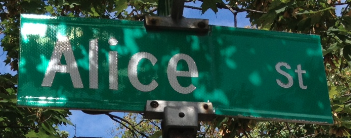
Yes, Alice Street is a small street on Ann Arbor's west side. 
No, it doesn't have anything to do with the ALICE program--
except that they share a name.
Photo by Ruth Kraut
In Article #1, Amy writes that Washtenaw County schools are giving teachers and other staff more flexibility in how to respond to outside threats from shooters or other assailants. This is called the ALICE program, which stands for Alert, Lockdown, Inform, Counter, Evaluate. This sounds like a great program and I'm glad that the schools are all on board for training on this program.

In Article #2 (which was actually published first), the school board discusses restricting access to schools in a major, major way--so that all doors will be locked to all schools during the school day. The cost--at this point--is estimated to be nearly $200,000 and to come out of the sinking fund.

According to the article:
This year, the district is planning to implement a new policy: Locking all exterior doors on school buildings during daytime hours. The implementation date has yet to be determined.
I don't believe the full board has voted on this. I got the impression from the article that they took a sense of the board but that voting on this will be on a future agenda.

But in order to lock all of the doors, they need to find a way to let people in. And therein lies the cost.

According to the article,
The district is considering several methods that would give certain individuals access to the building during school hours:

  • Using a keypad system in which parents and other qualified individuals get a code that will allow them access to a main door
  • Using a video surveillance and intercom buzzer system that only allows a staff member inside the building to admit someone in from the outside
What will this cost?
The estimated cost* to implement the new security measures is $190,000, which the district has allocated in its 2013-14 property upkeep budget funded by its sinking fund millage. The district also wants to replace all of its schools' exterior doors in the next five years should the sinking fund millage be renewed.
[*Slight digression: I'm not sure how we estimate the cost if we don't know what system we would use. My guess is that this estimate is quite low given the number of schools the district has.]

Do we need this system? Will it make our schools safer? 

I don't believe so.

As a parent, I think this is a terrible idea. It will overburden school office staff (who have already had additional duties added/cuts made over the past several years). It creates an impediment for parents coming into the building to volunteer or to pick up their children for doctor's appointments, for special presenters, for staff meetings.

And most importantly, those locked door policies give an illusion and false sense of security. In fact, in the Newtown, Connecticut shootings (referenced by Andy Thomas in the article), the schools had those locked door security measures. It didn't make a difference

[In the Columbine school shooting, there was an armed guard in the building. It also didn't make a difference.]


From CNNEarlier this year, the [ed. note: Newtown Sandy Hook elementary] school principal, Dawn Lafferty Hochsprung, ordered a new security system installed that required visitors to be visibly identified and buzzed in. As part of the security system, the school locked its doors each day at 9:30 a.m. The door was locked when the gunman arrived.

On December 19, 2012, after the Newtown Connecticut shooting, the Interdisciplinary Group on Preventing School and Community Violence, an impressive array of violence prevention researchers, including some who specialize in school security, put out a School Shooting Position Statement. They wrote:


"Inclinations to intensify security in schools should be reconsidered. We cannot and should not turn our schools into fortresses."
Right. I want our schools to be community centers.

Part of their statement reads:

Inclinations to intensify security in schools should be reconsidered. We cannot and should not turn our schools into fortresses. Effective prevention cannot wait until there is a gunman in a school parking lot. We need resources such as mental health supports and threat assessment teams in every school and community so that people can seek assistance when they recognize that someone is troubled and requires help. For communities, this speaks to a need for increased access to well integrated service structures across mental health, law enforcement, and related agencies. We must encourage people to seek help when they see that someone is embroiled in an intense, persistent conflict or is deeply
troubled. If we can recognize and ameliorate these kinds of situations, then we will be more able to prevent violence. These issues require attention at the school and community levels. We believe that research supports a thoughtful approach to safer schools, guided by four key elements: Balance, Communication, Connectedness, and Support, along with strengthened attention to mental health needs in the community, structured threat assessment approaches, revised policies on youth exposure to violent media, and increased efforts to limit inappropriate access to guns and especially, assault type weapons. 
The National Association of School Psychologists, in a 2013 position paper titled Research on School Security: The Impact of Security Measures on Students, writes:

The widespread public impression that schools are unsafe—fueled by rare, but highly visible school shootings—is contradicted by empirical evidence. (endnotes 22, 23) In fact, schools are not only safe, but are arguably safer today than they were a decade ago. (endnote 24)

Well, then, what would I suggest?

I am in favor of keeping most of the school's doors locked and directing access through the main door of each school. That makes sense to me. There will probably be some small cost in creating signs directing people to the main doors. And in some schools, you cannot see the door that is currently used as the main door from the main office. There probably should be some way to monitor those doors. At Ann Arbor Open, that involved adding another interior window to the Ann Arbor Open office.

And while we're discussing this, did you know. . . 

that although it is illegal to carry a concealed weapon into a school in Michigan, it is apparently legal to openly carry a weapon into a Michigan school? No, I'm not making that up. The father of a Clio-area child apparently did just that recently. Read more about the law and the "incident" here.


Other Good Ideas


The Interdisciplinary Group on Preventing School and Community Violence also wrote that:

Concerned students, parents, educators, and stakeholders in the community should attend to troubling behaviors that signal something is amiss. For example, if a person utters threats to engage in a violent act or displays a pronounced change of mood and related social behavior, or is engaged in a severe conflict with family members or coworkers, it makes sense to communicate concerns to others who might provide assistance. Early identification is important not only to prevent violence, but to provide troubled individuals the support, treatment, and help they need.
As far as I know, the only person who has been killed in a school in the last 30 (or more? maybe many more?) years in Washtenaw County was the Superintendent of the Chelsea Schools. A Chemistry teacher, Stephen Leith, who was being disciplined, left the school after a grievance hearing, and returned with a gun, killing Joseph Piasecki and injuring CHS principal Ronald Meade and English teacher Phil Jones (Managing Violence in the Workplace, Capozzoli and McVey, pp. 9-13). In hindsight--and I know, hindsight is perfect--the strategy suggested immediately above by the Interdisciplinary Group (a communications strategy) might have helped. Locked doors with key cards would have done nothing.


So, About That Sinking Fund Money...


Please don't spend our hard-earned sinking fund monies on this, because then it makes me feel like I shouldn't support the next round of the sinking fund millage. There is plenty of other important stuff to spend those funds on, and I want to vote for the next sinking fund millage, but if the school board votes to use this money on such a poorly-thought out idea, I am not sure I can do it.

And I will reiterate what I wrote above: locked door policies as proposed above have not been shown to be protective, and they are a waste of our money.



Thursday, July 4, 2013

A Look Back at Begole School in Ypsilanti

Happy July 4th! 

In honor of Independence Day, I thought a history post would be in order.

From a USGS 1:24,000 Topographic Map, Ypsilanti West Quad
I got this email in my inbox the other day: 
Ruth, I happened upon your school musings blog regarding early schools. The pictures of the tiny buildings reminded me of my old school. I grew up in Ypsi in the 60’s and went to Begole school before we moved to Detroit. Couldn’t tell you exactly where it was, but we lived on Gouchner road at the time. It seems it was just kindergarten and 1st grade at the time (possibly K-2), but us kindergarteners met in the basement each day. I’m sure they’ve torn down or re-purposed the building in the last 45 years as the town has grown, but it was pretty rural setting back then. Good memories. 
Anyway, thanks again for the article. Best regards always, Ken Kurtz

Of course, this piqued my interest, and I set out to see what I could find about Begole Grade School! (And by the way, the post that caught his eye was this one, about the beginnings of public schools in our country.)


Ken Kurtz sent me this picture. He wasn't sure it was Begole School, or even
who took it, but the picture looks just like one that the Ypsilanti Historical Society archives has,
except the archives picture doesn't have the school bus. I love,
love, love the bus in the front. If you click on the picture you will see it says
"Ypsilanti Public Schools" on the side and "School Bus" on the front.

In looking for information I found a great resource--the Ypsilanti Historical Society Archives. I guess I sort of knew about them from Laura Bien's Dusty Diary, but I'd never ventured into 220 N. Huron in Ypsilanti before. They are really helpful there! I hope to go back soon.

Here is what I found:

Begole School was located at the southwest corner of Ellsworth & Hewitt (on Hewitt). The land was originally given by the Begole family, who had land and farms in several locations, including where the Ann Arbor Airport is today. Frank Begole (Mac Begole's father) donated the land, and it appears that is how the school got named. The family was originally from France.


View Larger Map


I didn't find the date the school opened, although I found a woodcut print (at the bottom of this post) saying that it was built "before 1864." (I will update this if I find a more precise date). In any case, Begole School--a three-room schoolhouse--was closed in June 1971, with the opening of Ardis Elementary. That means that this school lived, and served, over 107 years' worth of students. Even though it was a small school, this school touched thousands of children.

(Ken went there from 1967-1968, and his sister Kris from 1966-1968, so they were not in the last classes.)

After the school was closed, it was leased the following year to the Washtenaw Intermediate School District. Later, it was used by the National Bank of Ypsilanti. The building existed for many years after that (it still shows up on some maps!)

It turns out that there were Begoles scattered across southeastern Michigan, and in fact there was a  Josiah Begole who was a U.S. Representative and was also the 19th Michigan governor. I couldn't find a direct connection, but there may be one.


This is the earliest item I found about Begole School. 
YPSILANTI TOWNSHIP Begole School In 1890 Phil Watling was the only student. His teacher would come to the corner of Michigan Avenue and Ellsworth roads, and if Phil were not in sight she would go home. In later years, when there was a lot of water across Ellsworth Road in the spring, Phil Watling carried the other children across because he was the biggest.
Taken from Washtenaw Impressions: Records of Meetings of the Washtenaw Historical Society, 1943, No. 4. Contents: Development in Rural Education in Washtenaw County by Julius Haab, County Commissioner of Schools. Found online at: http://impressions.washtenawhistory.org/impressions_1943_4o.pdf


Here is a picture from 1910.

The photo shows students posing at a Halloween party at Begole grade school in the 1910s. Courtesy of the Ypsilanti Historical Society. Found online at http://quod.lib.umich.edu/y/yhsic1/x-36/yhs00036.tif.
Next, I'll share a skit, published in the August 2000 edition of Ypsilanti Gleanings (the Ypsilanti Historical Society newsletter), that was performed at Begole School in the 1930s. It gives you a good sense of the humor of the era, and I particularly enjoyed the reference to marijuana! (I didn't think marijuana had much of a presence here in the 1930s...)
This article was a skit that was played at Begole School in the early 30's.
Judge: It has been a great pleasure and as you will see later, a rather sad session for me to be here. I have been requested to put before the people of this community the wonderful advantages which all of you have here, in the Begole School, you have one of the best of Rural Schools in Washtenaw County, as Miss Haas states. “We are noted for our cooperative spirit, and a smooth running school district is a striking example of the broad mindedness with a slice of educated people who are alive to the growing needs of the times.
Read the rest here
By the way, some Ypsilanti Historical Society documents are found at the Ann Arbor District Library (at least, online). However, more can be found in the archives of the Ypsilanti Historical Society. I encourage you to visit it! You can learn more about the Ypsilanti Historical Society and archive at their web site.

This woodcut print by Kathy Tobias was found in the Ypsilanti
Historical Society archives. 

AddThis