Five years ago today I started this blog. Read why here.
Five years, two children who have graduated from the Ann Arbor schools, one more with just 2-1/2 years left, educational policy in this state that goes from bad to worse.
I'm not sure what comes next with this blog. I do know that I have a lot of other things competing for my attention, and a lot of other interests that have gone untended.
I also know that there is a huge need for attention to be paid to the schools--much more than I anticipated when I started.
In the meantime, I expect the next year to be one of discernment regarding what I should do with this blog. It might continue, more or less as, or perhaps with a focus on higher level thoughts about education. I might be looking for someone else to take it over. Is that you? Or it might just remain, as a piece of history.
Consider subscribing to Ann Arbor Schools Musings by Email!

Information, news, and ideas about Ann Arbor, Washtenaw County, and Michigan schools; thoughts about education; and occasionally other stuff too.
Showing posts with label first thoughts. Show all posts
Showing posts with label first thoughts. Show all posts
Sunday, January 18, 2015


Monday, April 28, 2014
Choosing A Kindergarten, Ready for Graduation: Looking at the "Long Haul"
As I've written about before, when my oldest son was ready for kindergarten, I was choosing between the local Hebrew Day School, our local public school, and Ann Arbor Open.
On the side of the Hebrew Day School: all-day kindergarten; small classes; an immersion language curriculum; and a school that was willing to let us sit in on classes and observe.
On the side of Ann Arbor Open: multi-age classrooms; progressive education; and the requirement to volunteer and observe a classroom.
On the side of our local public school: basically, nothing, even though it has a stellar reputation, because I had myself experienced and loved "open" education. It had the same negatives as Ann Arbor Open (half-day kindergarten and larger class sizes than the private school) and--in my opinion--none of the positives. I couldn't sit in on a class there, and kindergarten roundup was very unsatisfying.
To round things out, my husband was a strong public schools proponent and thought we should try the public schools first.
In any case, I was reminded of this the other day when I heard someone say they were choosing between a private school or the new Northside STEAM program but were wondering about who the teachers would be at the STEAM school.
[Funny--I just realized I was never worried about the teacher quality at any of the schools I considered.]
I was giving the biggest weight to the full-day kindergarten.
One day I was talking to my colleague Cheryl, whose kids went to the Open School and were much older (like, fifth or sixth grade!)--and she said,
And so I did.
That was the best advice I ever got about choosing a school. If you don't want to be someone whose kids change school every year or two, then you need to think about the long haul.
Maybe because that conversation is embedded in my mind, it's hard to believe that this weekend, the little kid I was worried about then graduated from college.
Time flies when you're having fun!
(Just for fun: You can read a piece Gabe let me publish a few years ago when he was still in high school.)
Consider subscribing to Ann Arbor Schools Musings by Email!
On the side of the Hebrew Day School: all-day kindergarten; small classes; an immersion language curriculum; and a school that was willing to let us sit in on classes and observe.
On the side of Ann Arbor Open: multi-age classrooms; progressive education; and the requirement to volunteer and observe a classroom.
On the side of our local public school: basically, nothing, even though it has a stellar reputation, because I had myself experienced and loved "open" education. It had the same negatives as Ann Arbor Open (half-day kindergarten and larger class sizes than the private school) and--in my opinion--none of the positives. I couldn't sit in on a class there, and kindergarten roundup was very unsatisfying.
To round things out, my husband was a strong public schools proponent and thought we should try the public schools first.
 |
| That was then... |
[Funny--I just realized I was never worried about the teacher quality at any of the schools I considered.]
I was giving the biggest weight to the full-day kindergarten.
One day I was talking to my colleague Cheryl, whose kids went to the Open School and were much older (like, fifth or sixth grade!)--and she said,
"Ruth, kindergarten is only eight months long.
You have to look at the long haul!"
And so I did.
That was the best advice I ever got about choosing a school. If you don't want to be someone whose kids change school every year or two, then you need to think about the long haul.
 |
| Gabe and me: This is now! |
Maybe because that conversation is embedded in my mind, it's hard to believe that this weekend, the little kid I was worried about then graduated from college.
Time flies when you're having fun!
(Just for fun: You can read a piece Gabe let me publish a few years ago when he was still in high school.)
Consider subscribing to Ann Arbor Schools Musings by Email!
Friday, April 18, 2014
Alaska History Lesson: The Good Friday Earthquake
I was looking for some recent news about earthquakes, and I found the most fascinating information about the 50th anniversary of the Good Friday Earthquake in Alaska. Sometimes the web is a wonderland.
If you have some time this weekend, I highly recommend a documentary, Though the Earth Be Moved, of the first 72 hours after the earthquake. I couldn't get it to embed, but here is the link.
Here is a photo tour of Alaska after the earthquake.
Here are photos from the USGS Photographic Library and lots of additional information here.
Here is a fact sheet on Enduring Legacies. (It turns out that this earthquake helped prove a lot of theories about subduction zones and plate tectonics.)
Many films are available from the Alaska Film Archives.
And many more links can be found here.
All of this was fascinating, but it makes me glad I live in a state that doesn't have a lot of threats of natural disasters.
Consider subscribing to Ann Arbor Schools Musings by Email! It's worth every penny!
If you have some time this weekend, I highly recommend a documentary, Though the Earth Be Moved, of the first 72 hours after the earthquake. I couldn't get it to embed, but here is the link.
Here is a photo tour of Alaska after the earthquake.
Here are photos from the USGS Photographic Library and lots of additional information here.
Here is a fact sheet on Enduring Legacies. (It turns out that this earthquake helped prove a lot of theories about subduction zones and plate tectonics.)
Many films are available from the Alaska Film Archives.
And many more links can be found here.
All of this was fascinating, but it makes me glad I live in a state that doesn't have a lot of threats of natural disasters.
Consider subscribing to Ann Arbor Schools Musings by Email! It's worth every penny!
Tuesday, January 7, 2014
Introducing (Again): The Two-Hour Delay

Happy New Year!
Happy Cold Snowy New Year!
Happy Cold Snowy Beautiful New Year!
I am reposting this post from last year (Feb. 11, 2013), because it has been soooo cold, and tomorrow morning the warning is as follows:
... Wind chill warning remains in effect until 7 am EST Wednesday...
And kids are waiting for the school bus before 7 a.m. in some cases. So do we do another snow day? Or could we start a two-hour-delay trend? Why not?
Just saying...

Today was a snow day.
Now don't get me wrong. I love snow days, especially when there is snow to play in.
And I know that it was icy on the rural roads in the district at 5 a.m. But then it warmed up.
My friends in Pittsburgh (a city of many bridges that freeze) tell me that their schools often get a two-hour delay on days when it is icy in the morning but likely to warm up later.
I'm really not sure why none of our local schools seem to do this. It seems like this would have been the perfect solution in weather like today's.
And that is my bright idea!
Saturday, September 7, 2013
Ann Arbor's "Exceptional Schools" Campaign
This is the post where I come clean about something I've been repressing.
I cannot stand the Ann Arbor Public Schools "Exceptional" motto or advertising campaign.
Don't get me wrong, I think our schools vary from good to excellent. But exceptional? Come on.

I don't know who came up with the slogan (it has been around a long time), but I have never liked it. The new superintendent seems to be dragging the slogan into everything (it was in her 90-day plan, and in her opening day speech...) and I hope that stops!
Actually, I'd love a contest for a new slogan. Got any ideas?
I cannot stand the Ann Arbor Public Schools "Exceptional" motto or advertising campaign.
Don't get me wrong, I think our schools vary from good to excellent. But exceptional? Come on.

I don't know who came up with the slogan (it has been around a long time), but I have never liked it. The new superintendent seems to be dragging the slogan into everything (it was in her 90-day plan, and in her opening day speech...) and I hope that stops!
Actually, I'd love a contest for a new slogan. Got any ideas?
Tuesday, September 3, 2013
First Day of High School!
Today is the first day of high school for my son, and the first day of high school in the United States for our exchange student. For those of you with kids in school, or those of you who are teachers, have a great year!
 Part of a mural on the fence at Community High School. Mural by CHS and Angell students.
Here is a special shout out to the new Ypsilanti Community Schools district--good luck!
Saturday, June 22, 2013
The Challenges of Environmental Education in the 21st Century
Thirteen years ago, as I prepared to leave the Ecology Center, where I was an environmental educator, I wrote this piece for the Ecology Center newsletter. I recently rediscovered it, and to my (pleasant) surprise, it has held up rather well! Here is the link to the post on the Ecology Center page, and the link to the Ecology Center main page.
The Challenges of Environmental Education in the 21st Century
Lately, I've been thinking a lot about the challenges of environmental education. I've been thinking about why it's so critical, yet often ignored by organizers and policy makers; spoken of with great passion, yet underfunded; maligned as "biased" and appropriated by corporations anxious to show environmental concern. Perhaps it's not surprising that I've been thinking about this, because I've been working in the environmental education field consistently for the last eleven years and fitfully for the last twenty. And now, I'm preparing to go back to school and of course as part of this a bit of reflection seems necessary.
The first challenge -- funding. With school spending facing its own challenges, with grantors tending to be more interested in policy rather than education, and with self-imposed limits on taking funds from polluters which we employ at the Ecology Center, finding money for our environmental education programs has always been difficult. That's one reason that we were so grateful to see a wonderful response to our Special Environmental Education Appeal. From the smallest checks of two and three dollars, to the two hundred dollar checks, every single one was also a message saying, "We believe in the power of environmental education."
The second challenge is one of delivering appropriate, relevant, and important information well. No teacher likes to teach the same thing year after year after year (it gets boring). Yet, every year we have a different crop of third graders. The material is new to them and still relevant and important. We always need to make it fresh for ourselves, too!
The third challenge is internal to the organizations doing environmental education. We do other things too, such as advocacy; we have limited time. Sometimes it seems less important to teach those third graders basic information (such as how water can get polluted) when there is a pressing policy issue. Environmental educators are prone to saying that "the students of today will be the policy makers of the future." Sometimes I would say it and not really believe it. But I recently realized just how true it is, when I found out that a student who volunteered at the Ecology Center as a high school student is now working for the Sierra Club's national office on policy issues.
The last challenge I'll mention today is perhaps the most daunting. It is educating people so that they really care about the environment. I've been thinking about the "spark." How did you become interested and concerned in the environment? Was it camping, fishing, hunting, hiking with a friend or relative? Was it participating in a biology class or reading a book like Silent Spring?
 |
| Rachel Carson, US Fish & Wildlife Employee Photo, found online here. |

The feminist movement (Ms. Magazine, actually) called the moment where you internalize the feminist world-view a "click" moment, where all of a sudden everything "clicks" into place. Rachel Carson, in her engaging book A Sense of Wonder, suggests that "If a child is to keep alive his inborn sense of wonder without any such gift from the fairies, he needs the companionship of at least one adult who can share it." Developing that sense of wonder, internalizing it, and capitalizing on it is perhaps the biggest challenge, and is sometimes called the "teachable moment." The teachable moment is when things fall into place so that you can teach and others can learn.
Sometimes people ask me how I ended up an environmental studies major. I was already interested in the environment from camping and hiking and growing up on Long Island Sound. But I remember one semester in college taking a biology class, a geology class, and an environmental studies class. It so happened that over the course of a couple of weeks we studied Darwin in each of those classes. And in each class, we learned something different about his work and how it has influenced science, social science, and Western thought. This collection of experiences was my personal environmental "click" moment. I realized that I couldlearn something from the interdisciplinary nature of environmental studies, and in this case, that the whole was bigger than the sum of its parts. So in this case, the teachable moment was actually a collection of moments, and my professors never knew about it.
Ultimately, the challenge of environmental education is, like all education, to find the teachable moment. And to capitalize on that moment, so that the person who is in the position to be taught not only learns the facts, but internalizes them. Then they can say, "Yes, I am an environmentalist, and I believe that what I do makes a difference." It does.
Ruth Kraut has worked at the Ecology Center since 1986. In September, she will be starting at the University of Michigan to get an M.A. in Education and an M.P.H. in Public Health.
Sunday, April 7, 2013
Determinative Architecture and the Roberto Clemente School
Is determinative architecture even a term?
I'm trying to use a phrase that says that architecture can determine a building's uses. Take your nearest cathedral. The architect tries to give you a soaring, celestial feeling with those high arches and stained glass windows.
Now imagine how classes might flow in a school built in the sixties or seventies with partial walls and everyone facing into a central pod for a media center. (This could describe the new part of Ann Arbor Open or Logan Elementary.)
Compare that to the high walls and solid building of Eberwhite, Bach, or the oldest part of Ann Arbor Open at Mack. Not only are the halls and classrooms much quieter than in the "open" structure, but the building itself also causes teachers and students to act differently.
When my oldest son was in kindergarten at what was then Bach Open School (at Bach), the kindergarten/first grade teacher had a very large room. There was plenty of room for a very large set of blocks that were a kid favorite.
Between my son's kindergarten and first grade years, the Open School moved to Mack. The classrooms in the newer part of the building were much smaller. Goodbye blocks :(
The Roberto Clemente Building
The Roberto Clemente program was conceived of in 1973 and became reality in 1974. Its original name was the Alternative School for Disruptive Youth [Flattering! I'm sure that attracted lots of kids!].
Early on the name was changed to honor Roberto Clemente, the Pittsburgh Pirates player who died in a plane crash on his way to a humanitarian mission in Nicaragua after the devastating 1972 earthquake. [Fun factoid about my family--my oldest son early on adopted Roberto Clemente's number as his own for his baseball jersey, and my youngest son has followed that tradition. That's #21, in case you didn't know.]
The Roberto Clemente program was located way out of town for many years. According to this history, it was located at Meadowview Elementary on Textile Road in Pittsfield Township. I remember wondering if the building was even within the school district boundaries.
Plans for the current location were developed in the early 1990s, and the Roberto Clemente school building opened in 1994. When the plans were developed, Joe Dulin, the principal and founder, had in mind one key trait: class size. Knowing that there was a risk that class sizes would rise, he intentionally worked to keep the room sizes small, because he believed--and, I should say, still believes (he has spoken recently at a school board meeting) that small class sizes are the key to the school's success. Make the rooms small, he thought, and you can't really make the classes too large.
They also, intentionally, built the school off of bus routes.
Roberto Clemente is a school where many of the kids have failed in other school settings. Roberto Clemente is a school where many of the kids come from low-income households, thus it is a Title I school. Roberto Clemente is also a school with many kids who qualify for special education services. All of those things add to the per-pupil cost of the school, which today is approximately twice that of the comprehensive high schools. (Title I designation and special education funds though, are revenue streams into the school as well.) But undoubtedly, the key reason that the school's per-pupil costs are so high is that the classes are so small--and the school itself is small.
Class sizes are generally 15 kids or fewer, and. . . here is the kicker. . . if the school wanted to lower their per-pupil costs, they would need to make the class sizes larger. The classrooms, however, are meant to fit class sizes of 15 students or fewer. The architecture determines the use.
You see where this is going, right? It's a bit of a Catch-22. In order to be successful, the classes need to be small, but in order to lower the schools' costs, the class sizes would likely need to be larger. Yet the current building structure will not allow that (at least, not without significant renovations).
If the school were to move, would the class sizes balloon? Would the school (or in this case, the program) still be able to effectively serve those students?
Joe Dulin's plan seemed like a good one in 1994 (pre-Proposal A). With the threat of the program's elimination or with potential plans that the school be moved to Ann Arbor Tech or Pioneer, does it seem like a good plan now?
I'm trying to use a phrase that says that architecture can determine a building's uses. Take your nearest cathedral. The architect tries to give you a soaring, celestial feeling with those high arches and stained glass windows.
 |
| An interior northeast view of the Sagrada Familia in Barcelona, Spain. By Jnolan14 (Own work) [CC-BY-SA-3.0 (http://creativecommons.org/licenses/by-sa/3.0)], via Wikimedia Commons |
Now imagine how classes might flow in a school built in the sixties or seventies with partial walls and everyone facing into a central pod for a media center. (This could describe the new part of Ann Arbor Open or Logan Elementary.)
 |
| Logan Elementary, picture from a2schools.org, Ann Arbor Public Schools |
Compare that to the high walls and solid building of Eberwhite, Bach, or the oldest part of Ann Arbor Open at Mack. Not only are the halls and classrooms much quieter than in the "open" structure, but the building itself also causes teachers and students to act differently.
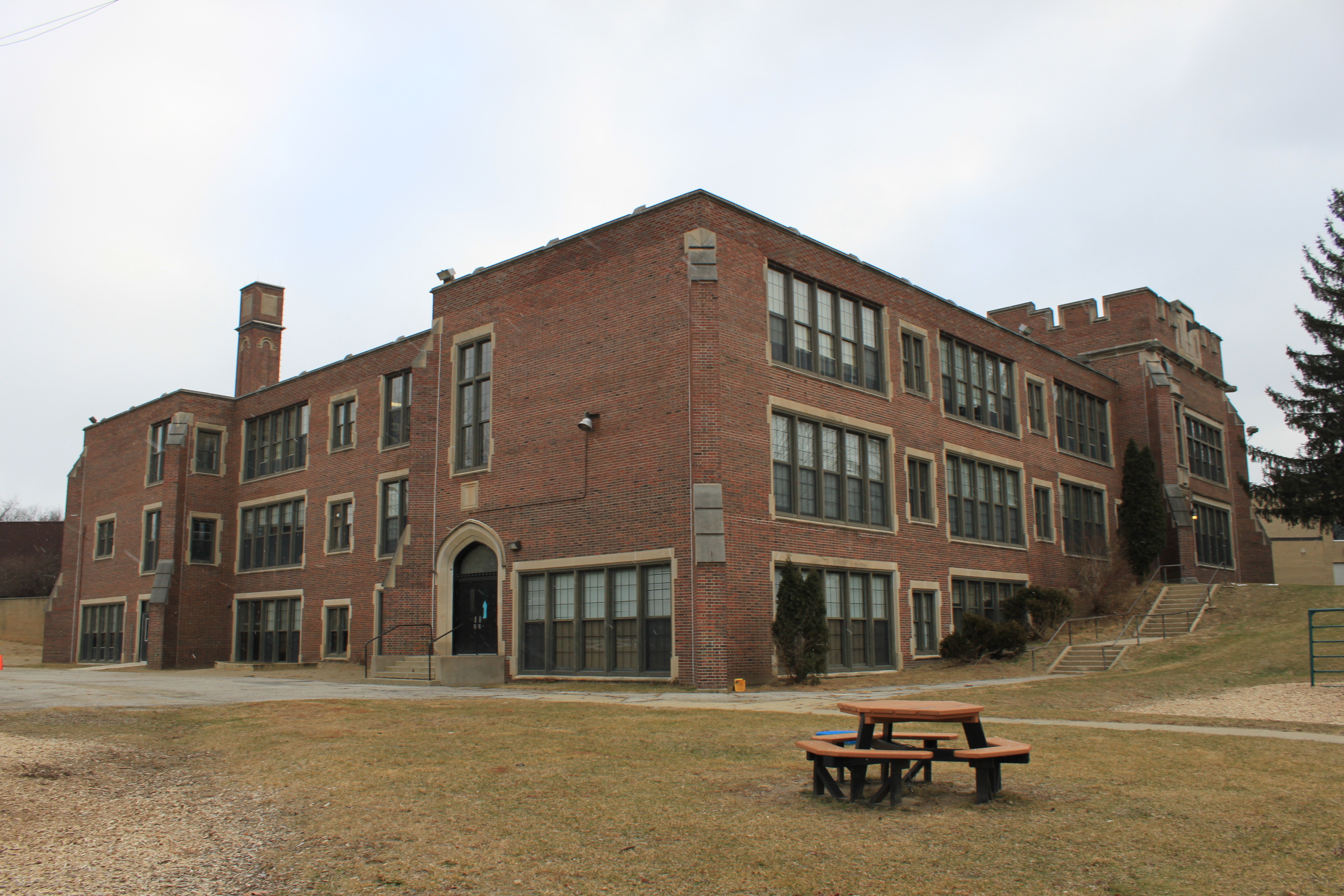 |
| The older part of Ann Arbor Open at Mack. By Dwight Burdette (Own work) [CC-BY-3.0 (http://creativecommons.org/licenses/by/3.0)], via Wikimedia Commons |
When my oldest son was in kindergarten at what was then Bach Open School (at Bach), the kindergarten/first grade teacher had a very large room. There was plenty of room for a very large set of blocks that were a kid favorite.
 |
| I took these from daycaremall.com. Those large blocks looked something like these. |
Between my son's kindergarten and first grade years, the Open School moved to Mack. The classrooms in the newer part of the building were much smaller. Goodbye blocks :(
The Roberto Clemente Building
The Roberto Clemente program was conceived of in 1973 and became reality in 1974. Its original name was the Alternative School for Disruptive Youth [Flattering! I'm sure that attracted lots of kids!].
Early on the name was changed to honor Roberto Clemente, the Pittsburgh Pirates player who died in a plane crash on his way to a humanitarian mission in Nicaragua after the devastating 1972 earthquake. [Fun factoid about my family--my oldest son early on adopted Roberto Clemente's number as his own for his baseball jersey, and my youngest son has followed that tradition. That's #21, in case you didn't know.]
The Roberto Clemente program was located way out of town for many years. According to this history, it was located at Meadowview Elementary on Textile Road in Pittsfield Township. I remember wondering if the building was even within the school district boundaries.
 |
| Roberto Clemente School, built in 1994; taken from the Pittsfield Township Historical Society web site |
Plans for the current location were developed in the early 1990s, and the Roberto Clemente school building opened in 1994. When the plans were developed, Joe Dulin, the principal and founder, had in mind one key trait: class size. Knowing that there was a risk that class sizes would rise, he intentionally worked to keep the room sizes small, because he believed--and, I should say, still believes (he has spoken recently at a school board meeting) that small class sizes are the key to the school's success. Make the rooms small, he thought, and you can't really make the classes too large.
They also, intentionally, built the school off of bus routes.
Roberto Clemente is a school where many of the kids have failed in other school settings. Roberto Clemente is a school where many of the kids come from low-income households, thus it is a Title I school. Roberto Clemente is also a school with many kids who qualify for special education services. All of those things add to the per-pupil cost of the school, which today is approximately twice that of the comprehensive high schools. (Title I designation and special education funds though, are revenue streams into the school as well.) But undoubtedly, the key reason that the school's per-pupil costs are so high is that the classes are so small--and the school itself is small.
Class sizes are generally 15 kids or fewer, and. . . here is the kicker. . . if the school wanted to lower their per-pupil costs, they would need to make the class sizes larger. The classrooms, however, are meant to fit class sizes of 15 students or fewer. The architecture determines the use.
You see where this is going, right? It's a bit of a Catch-22. In order to be successful, the classes need to be small, but in order to lower the schools' costs, the class sizes would likely need to be larger. Yet the current building structure will not allow that (at least, not without significant renovations).
If the school were to move, would the class sizes balloon? Would the school (or in this case, the program) still be able to effectively serve those students?
Joe Dulin's plan seemed like a good one in 1994 (pre-Proposal A). With the threat of the program's elimination or with potential plans that the school be moved to Ann Arbor Tech or Pioneer, does it seem like a good plan now?
Tuesday, December 18, 2012
Teachers: Paragon or Pariah?
Friday, I got an email from my sister at one in the afternoon.
"Lynn's kids were at that school. They are safe."
One of my sister's oldest friends has kids at Sandy Hook Elementary. They survived. The fact that I actually knew someone with kids at the school changed my relationship to the tragedy. Made it more personal, and less distant.
This weekend--like many of you, I am quite sure--I have spent quite a bit of time reading about Sandy Hook Elementary. And I have been thinking about the adults, all people who worked in the schools, with children.
I've been thinking about some of the ways we have talked about teachers and other school staff. In fact, I even heard one of the Sandy Hook parents say something along these lines in an NPR interview today. In lifting up one of the teachers who was murdered, she said something like this, "She wasn't one of those teachers who was done at 3 p.m. She always went the extra mile."
Speaking to teachers around here, many of them are feeling under attack and undervalued. Yet here we see the teachers and administrators at Sandy Hook lauded as heroes and wonderful teachers. [Don't get me wrong--they were heroes. But their heroic action has to do with the way they protected their students, and not how they taught their students.] Were they also all above-average teachers? [I have no idea. Is Newtown Lake Wobegon?]
In hindsight, everyone says yes. The truth is, even though a lot of so-called educational reformers are busy slamming teachers, it has been my experience that most people I know like and value their kids' teachers.
Now I wonder, is this more proof of the feminist analysis that says that in public discourse, women [and most teachers are women] are either put on a pedestal (described as a Madonna) or vilified (described as a whore).
If you haven't done so already this year, take a moment to thank your school's teachers, administrators, custodians, "lunch ladies." This doesn't require money--a handwritten note or even an email will do.
And if you like to make resolutions, might I suggest this one? Next year, pledge not to put school staff on pedestals as paragons of virtue, or vilify them as pariahs. Next year, pledge to treat them as the people with jobs that most of them are, people who are trying to do a good job and may sometimes fall short. Next year, pledge to thank them more, and support them when you can.
"Lynn's kids were at that school. They are safe."
One of my sister's oldest friends has kids at Sandy Hook Elementary. They survived. The fact that I actually knew someone with kids at the school changed my relationship to the tragedy. Made it more personal, and less distant.
This weekend--like many of you, I am quite sure--I have spent quite a bit of time reading about Sandy Hook Elementary. And I have been thinking about the adults, all people who worked in the schools, with children.
I've been thinking about some of the ways we have talked about teachers and other school staff. In fact, I even heard one of the Sandy Hook parents say something along these lines in an NPR interview today. In lifting up one of the teachers who was murdered, she said something like this, "She wasn't one of those teachers who was done at 3 p.m. She always went the extra mile."
Speaking to teachers around here, many of them are feeling under attack and undervalued. Yet here we see the teachers and administrators at Sandy Hook lauded as heroes and wonderful teachers. [Don't get me wrong--they were heroes. But their heroic action has to do with the way they protected their students, and not how they taught their students.] Were they also all above-average teachers? [I have no idea. Is Newtown Lake Wobegon?]
In hindsight, everyone says yes. The truth is, even though a lot of so-called educational reformers are busy slamming teachers, it has been my experience that most people I know like and value their kids' teachers.
Now I wonder, is this more proof of the feminist analysis that says that in public discourse, women [and most teachers are women] are either put on a pedestal (described as a Madonna) or vilified (described as a whore).
If you haven't done so already this year, take a moment to thank your school's teachers, administrators, custodians, "lunch ladies." This doesn't require money--a handwritten note or even an email will do.
And if you like to make resolutions, might I suggest this one? Next year, pledge not to put school staff on pedestals as paragons of virtue, or vilify them as pariahs. Next year, pledge to treat them as the people with jobs that most of them are, people who are trying to do a good job and may sometimes fall short. Next year, pledge to thank them more, and support them when you can.
Saturday, August 25, 2012
Preschool: Ecology, Pacifism, Solidarity

I recently got back from Montreal, where I found this lovely mural on a "Service de Garde," or preschool/child care center. And seriously--where in the United States would you find a mural on a school (even a child care center!) that promotes ecology, pacifism, and solidarity? (If you find one, send me a picture!)
Thursday, July 19, 2012
School Supplies

It reminded me of something that happened mid-year. I was cleaning out a shelf, and I found a surfeit of pencils. So I asked my son if he needed some for school.
"Oh no," he said.
"Really? You don't need them? You still have plenty of pencils from the ones I got at the beginning of the year?"
"No," he said.
"Then how do you get pencils?" I asked.
"Oh," he said, "I just find them on the floor!"
Perhaps your children are not quite as enterprising as my son.
Seriously, I do have money for school supplies. But not everybody does, and if you can't afford them, the beginning of school is stressful. Washtenaw County employees are trying to fill a school bus with school supplies. From 9 a.m. to 3 p.m., July 30th-August 3, the school bus can be found in front of the Target store, 3749 Carpenter Road, Pittsfield Township. Supplies will be given to Washtenaw County kids who need them.
If you miss that drive, many of the local shelters collect school supplies (and other supplies too) year-round.
Monday, May 21, 2012
The Accidental Essay: Thoughts About Ypsilanti's Budget
A few weeks ago, I asked a person who sometimes comments on this blog as YpsiAnon to write about the potential consolidation of the Ypsilanti and Willow Run schools. She said she would when she had time, in about a month. In the meantime, there has been a lot of discussion in Ypsilanti about some very draconian budget cuts, and when she came back to me, it was with what she called an "accidental essay." I think it's fantastic and thought-provoking, and I hope you will too. It's my first guest post! (You, by the way, are welcome to contact me directly if you are interested in writing a guest post.)
Thanks YpsiAnon!
Thanks YpsiAnon!
You know how you can hear about a terrible disaster that kills thousands of people and it doesn’t affect you nearly as much as knowing one person who has died from the same thing? The former is just too big to comprehend, while the latter is much more meaningful. It’s kind of like this with the school district’s financial crisis. We’ve heard for years about the deficit elimination plan, and sort of understood that millions of dollars were involved. We’ve heard for months about the budget crisis being worse than we understood, and that now $14 million would need to be cut. $14 million is just impossible to fathom. But when the cuts are announced, and it’s your school or your band program that’s affected, then it is real.
How dire are things in Ypsilanti? Here is an example that hits close to home for me, since I have a band student at Ypsilanti High School. (Please note that the figures below were shared with me by a couple of YHS sources. I trust, but cannot presently verify, their accuracy.)
In Ypsi, the budgets have become building-based, where a lump sum is given to the building principal, who must determine how it is spent. Next year, for Ypsi High School, I am told that this amount is in the $65,000 neighborhood. This money is intended to cover all expenses, which have typically included copier costs (paper and ink), textbooks, phone service, mailings (including report cards), band instrument repair, band transportation, choir camp, science class supplies, and even light bulbs. It also includes substitute teacher costs, which are estimated at about $60,000 for next year. Go ahead and do the math. Yes, that would mean that $5,000 remains for all those other expenses (plus some I didn’t mention) once you deduct the sub costs, and I imagine sub costs are less negotiable, perhaps due to contract issues.
I’m told that copy-related costs are around $80,000. Should we go without copies? Currently, a monthly limit of 250 copies/teacher has been allotted, regardless of whether teachers provide their own paper—toner is expensive, too! (There goes my plan to give the teachers a ream of paper each fall instead of Kleenex.) Teachers are trying to be creative, doing what they can online, for example, but most classrooms have about 4 student computers, so that’s not usually a viable option for an entire class.
I’m also told that phone service for the building costs about $5,000. Should we go without phones?
Should we not replace and/or replenish textbooks? How about light bulbs?
As the abstraction of $14 million becomes concrete, the public will be in shock, which will quickly turn to anger and blame. “Cut the administration! They are overpaid and incompetent!” “Cut sports! They don’t help our test scores!” “Cut transportation! My kid doesn’t ride the bus!” “Cut everything—except the things I value!” And then it is just a reflection of the divisiveness of the greater world. Hard as it may be, this is not the time to divide; instead, we need to find ways to work together and try to solve this problem.
The band budget used to include $5,000 for repairs, $5,000 for equipment, and $14,000 for band transportation (most of it to/from band camp). It’s difficult to imagine that any of that will exist, given the circumstances. What do we, as band families, do next? Some might try to influence the district’s decision-makers by pleading our case. (Frankly, I think band costs should be part of the public relations budget, for as much as marching band and jazz band represent the school district to the greater community.) Some might try to find new sources of money, such as grants. Some might launch new fundraisers. Some might plan to kick in more money when the band camp bill comes due. Some might even think about running for school board… Whatever it is, we need to do something, not nothing.Whether you are from Ypsilanti or Ann Arbor or Chelsea, this story either describes what your district is going through now, or what it will be going through. Maybe it will reassure you that your activism is justified, or maybe it will motivate you to become more involved. I hope something good will come of it.
How dire are things in Ypsilanti? Here is an example that hits close to home for me, since I have a band student at Ypsilanti High School. (Please note that the figures below were shared with me by a couple of YHS sources. I trust, but cannot presently verify, their accuracy.)
In Ypsi, the budgets have become building-based, where a lump sum is given to the building principal, who must determine how it is spent. Next year, for Ypsi High School, I am told that this amount is in the $65,000 neighborhood. This money is intended to cover all expenses, which have typically included copier costs (paper and ink), textbooks, phone service, mailings (including report cards), band instrument repair, band transportation, choir camp, science class supplies, and even light bulbs. It also includes substitute teacher costs, which are estimated at about $60,000 for next year. Go ahead and do the math. Yes, that would mean that $5,000 remains for all those other expenses (plus some I didn’t mention) once you deduct the sub costs, and I imagine sub costs are less negotiable, perhaps due to contract issues.
I’m told that copy-related costs are around $80,000. Should we go without copies? Currently, a monthly limit of 250 copies/teacher has been allotted, regardless of whether teachers provide their own paper—toner is expensive, too! (There goes my plan to give the teachers a ream of paper each fall instead of Kleenex.) Teachers are trying to be creative, doing what they can online, for example, but most classrooms have about 4 student computers, so that’s not usually a viable option for an entire class.
I’m also told that phone service for the building costs about $5,000. Should we go without phones?
Should we not replace and/or replenish textbooks? How about light bulbs?
As the abstraction of $14 million becomes concrete, the public will be in shock, which will quickly turn to anger and blame. “Cut the administration! They are overpaid and incompetent!” “Cut sports! They don’t help our test scores!” “Cut transportation! My kid doesn’t ride the bus!” “Cut everything—except the things I value!” And then it is just a reflection of the divisiveness of the greater world. Hard as it may be, this is not the time to divide; instead, we need to find ways to work together and try to solve this problem.
The band budget used to include $5,000 for repairs, $5,000 for equipment, and $14,000 for band transportation (most of it to/from band camp). It’s difficult to imagine that any of that will exist, given the circumstances. What do we, as band families, do next? Some might try to influence the district’s decision-makers by pleading our case. (Frankly, I think band costs should be part of the public relations budget, for as much as marching band and jazz band represent the school district to the greater community.) Some might try to find new sources of money, such as grants. Some might launch new fundraisers. Some might plan to kick in more money when the band camp bill comes due. Some might even think about running for school board… Whatever it is, we need to do something, not nothing.Whether you are from Ypsilanti or Ann Arbor or Chelsea, this story either describes what your district is going through now, or what it will be going through. Maybe it will reassure you that your activism is justified, or maybe it will motivate you to become more involved. I hope something good will come of it.
Wednesday, May 2, 2012
Observation and the Science of Journalism
Today the Ann Arbor Chronicle has a "monthly milestone" column by Dave Askins on the "science" of journalism. It's an essay that discusses why the Chronicle has chosen a writing model that privileges describing (what happened at a meeting) over storytelling (about the meeting). I found it thought-provoking, and you can find it here.
[As an aside: I also had to look up an old Ann Arbor News article on microfilm today. It really made me miss the (old) Ann Arbor News--the article was from the mid-1980s, and although there was a story-telling aspect to the article, it was also very information-dense, which is another thing I don't see a lot of these days in most journalism outlets.]
In any case--back to my main point here. Askins writes,
One day we were discussing teaching methods, and Bonnie told me that her students spent a lot of time drawing. She would place an object--a shell, a piece of wood, a stone--on each table, and her students would draw. I was surprised, but she said, "Most of these students don't spend very much time looking at things and thinking about what they really look like." In fact, drawing really is a good way to observe, and observation really is a building block for good science. Therefore, encouraging observation--real, finely detailed observation--should be foundational to science education. Is it?
[As an aside: I also had to look up an old Ann Arbor News article on microfilm today. It really made me miss the (old) Ann Arbor News--the article was from the mid-1980s, and although there was a story-telling aspect to the article, it was also very information-dense, which is another thing I don't see a lot of these days in most journalism outlets.]
In any case--back to my main point here. Askins writes,
The lab manual for my first course in high school chemistry was called “Merrill Laboratory Chemistry,” co-authored by my teacher, David Haines. As I recall it, the first laboratory experiment involved lighting a candle and then watching it burn for an entire class period. The laboratory task was to record in the lab manual just what we saw happening.Dave's point, that we often analyze when we should perhaps describe, reminded me of a college friend who is an artist now. Like me, she was an environmental studies major. At the time of the discussion I'm going to tell you about, she was experimenting with her art, but she was making a living as a middle school science teacher at a Friends' (Quaker) school in Philadelphia.
That was a quintessentially descriptive task. And it’s not as easy as you might think, once you grasp what’s meant by “description” in this context.
For example, here’s the effort of a hypothetical student at this descriptive task:
Candle is burning.I think it’s a poor effort. It’s not a poor effort by dint of a lack of detail. It’s a poor effort because it uses words that are already analytical, instead of purely descriptive. A possible commentary on that “description”:
Burning candle, wax is starting to melt.
Liquid wax is dripping down the sides of the burning candle.
Candle is getting shorter.
Flame is flickering.
You’ve used this word, “burning.” What do you mean by that? Do you mean to be talking about phlogiston leaving the candle? Or do you mean to be referring to a chemical reaction involving oxygen? Do you really mean to be describing the three-dimensional orangish, yellowish area above the white cylinder that’s shaped roughly like a teardrop and that moves around a bit?
Or take these words “melt” and “liquid.” What’s that exactly? Why are you convinced that the translucent stuff you’re seeing at the top of the white cylinder that tends to move around a bit is made of the same stuff the white cylinder is made of? Is that something you can see? Or have you already analyzed this situation, because you think you know what’s going on? What if that translucent stuff is being created by the orangish area out of some stuff in the air and deposited there on top of the white cylinder?
One day we were discussing teaching methods, and Bonnie told me that her students spent a lot of time drawing. She would place an object--a shell, a piece of wood, a stone--on each table, and her students would draw. I was surprised, but she said, "Most of these students don't spend very much time looking at things and thinking about what they really look like." In fact, drawing really is a good way to observe, and observation really is a building block for good science. Therefore, encouraging observation--real, finely detailed observation--should be foundational to science education. Is it?
Monday, March 12, 2012
Testing Tales
I'm hoping to do a series about testing--talking about the MEAP, the MAP, the ACT, the SAT, the MME, etc. But it's such a vast subject and I've been a little bit stymied as to how to break it up. Add to that conundrum a busy schedule and I've been thinking about how to write this up for a couple of months now, but I haven't actually set pen to paper [rereading this, I feel I should note--that is just a figure of speech!]. Now I have decided I will move from inward to outward. In other words, I'm going to start with myself.
I've never been a particularly anti-test person. I always thought that test taking was a skill that people needed, just like writing, arithmetic, or learning how to tie a shoelace. But I also thought we shouldn't overemphasis tests.
For myself, I have pleasant memories of filing into the school cafeteria to take the Iowa tests. I was lucky that my name wasn't something long like Smolensky or Blagojevich [sneaky reference to a former Illinois governor who is going to jail this week] because they were too long to fit in the bubbles. And of course I made sure to fill in the bubbles well with my newly-sharpened #2 pencil.
Do you remember the Iowa tests? They have a long history. They were first developed in 1935. The Iowa tests are what are called "norm-referenced" tests. In other words, they score test-takers on a bell curve. Some students will be above average; the majority will be average; and some students will be below average. [Below, there is a drawing of a bell curve. See how it looks like a bell? Hence the name.]
The idea behind a norm-referenced test is that it describes a population's distribution. In other words, not everyone will perform well--some people will perform poorly. But in a particular population (say, for example, Lake Wobegon, where "all the children are above average,") all of the kids could score to the right of the center line--and would look good when compared Lake Woestayhere, where all the kids are below average.
On the other hand, you can see the problem. In the broader population, it is impossible for everybody to score well. Half the test-takers would have to be below average. If a large population moves its scores (everyone starts reading better), then the bell curve shifts to the right--but still, half the kids are below average. Also, norm-referenced tests tend to focus on the kinds of questions that differentiate between students, and not the kinds of questions that show proficiency in certain areas. In other words, the point of the test is to rank students.
If, by chance, you have ever had a teacher who "graded on the curve" or "curved the grades," that teacher was working toward a certain middle ground. If she or he expected that most of the class would get a B, but the average grade was a C, they might think "I guess I made that test too hard" and they would move the average up to a B. I was very thankful for that in college physics, where my C- turned into a B- thanks to a professor's curving of the final exam.
In my test-taking heyday--which might have been eighth or ninth grade--I enjoyed the tests as a break from my regular school work. I enjoyed completely filling in the circles. I didn't feel any pressure about the tests, because a) they didn't mean much of anything and b) I always scored well on tests. In other words, whether it was an Iowa test or an IQ test (which is also scored on the bell curve), I was always well along on the right-hand side of that curve.
I never had test anxiety, which definitely helped.
But it's also true that students who fit my profile tended to do well. And of course, doing well is positively reinforcing. And since I did well the first time, why get nervous about the next year's test?
What, you might wonder, is "my profile?" Well, to begin with, I lived in a primarily white, upper middle/middle class town. I had two well-educated parents, both with graduate degrees. I had lots of books in my house. Only one of my grandparents had finished high school, but they all could read in more than one language. It turns out that the confluence of a comfortable income and an educated, literate family lead a certain population to do very well on tests. And that is true, whether the test is a norm-referenced test like the Iowa tests, or a criterion-referenced test like the MEAP.
Criterion-referenced tests sound, on paper, a lot better. In a sense, they are more like the kinds of tests that we took in high school. If you were taught the future tense in a language class, you would be expected to demonstrate that knowledge on a test. Theoretically, every student in the class could get an A if they had studied and mastered the future tense. And in this simple example, that might actually happen.
In real life, in criterion-referenced tests like the MEAP, that never happens. There are a lot of reasons for this, but here are a few.
1. Students come in with different weaknesses. If one of those weaknesses is reading, that will show up in every single other test. The social studies and science tests--and even the math tests--require a lot of reading.
2. The "cut scores," as to what "proficiency" means, change. That just happened this year in Michigan, and guess what--a lot of kids who looked "proficient" last year don't look proficient this year. Even though they might have actually done better.
3. Not all teachers teach everything that might be on the tests. And even if they cover the subject matter, the questions might be unintelligible to the student. Take, for instance, an example that a teacher gave me a few years ago. Her students (upper elementary) had a question on the reading comprehension exam about logging. Yes, I'm talking about the cutting down of trees. Her students, however, had a different understanding of logging. One logs into a computer, and logs out of a computer. . . That reading comprehension passage made no sense at all to those kids.
But anyway, back to me. I've now had two children go through the college application process. They've taken a lot of tests. Like me when I was growing up, they have two parents with graduate degrees. Like me growing up, they live in a middle class community--and an academic community too! That is another kind of privilege. Like me, they did relatively well.
And my youngest son? He said to me, "I like the tests."
"Really? Why?" I asked.
"Well," he said, "we don't do any work during the testing periods!"
And that's Part I. More about testing, coming soon to a blog near you.
I've never been a particularly anti-test person. I always thought that test taking was a skill that people needed, just like writing, arithmetic, or learning how to tie a shoelace. But I also thought we shouldn't overemphasis tests.
For myself, I have pleasant memories of filing into the school cafeteria to take the Iowa tests. I was lucky that my name wasn't something long like Smolensky or Blagojevich [sneaky reference to a former Illinois governor who is going to jail this week] because they were too long to fit in the bubbles. And of course I made sure to fill in the bubbles well with my newly-sharpened #2 pencil.
Do you remember the Iowa tests? They have a long history. They were first developed in 1935. The Iowa tests are what are called "norm-referenced" tests. In other words, they score test-takers on a bell curve. Some students will be above average; the majority will be average; and some students will be below average. [Below, there is a drawing of a bell curve. See how it looks like a bell? Hence the name.]
 | |
| The Bell Curve |
On the other hand, you can see the problem. In the broader population, it is impossible for everybody to score well. Half the test-takers would have to be below average. If a large population moves its scores (everyone starts reading better), then the bell curve shifts to the right--but still, half the kids are below average. Also, norm-referenced tests tend to focus on the kinds of questions that differentiate between students, and not the kinds of questions that show proficiency in certain areas. In other words, the point of the test is to rank students.
If, by chance, you have ever had a teacher who "graded on the curve" or "curved the grades," that teacher was working toward a certain middle ground. If she or he expected that most of the class would get a B, but the average grade was a C, they might think "I guess I made that test too hard" and they would move the average up to a B. I was very thankful for that in college physics, where my C- turned into a B- thanks to a professor's curving of the final exam.
In my test-taking heyday--which might have been eighth or ninth grade--I enjoyed the tests as a break from my regular school work. I enjoyed completely filling in the circles. I didn't feel any pressure about the tests, because a) they didn't mean much of anything and b) I always scored well on tests. In other words, whether it was an Iowa test or an IQ test (which is also scored on the bell curve), I was always well along on the right-hand side of that curve.
I never had test anxiety, which definitely helped.
But it's also true that students who fit my profile tended to do well. And of course, doing well is positively reinforcing. And since I did well the first time, why get nervous about the next year's test?
What, you might wonder, is "my profile?" Well, to begin with, I lived in a primarily white, upper middle/middle class town. I had two well-educated parents, both with graduate degrees. I had lots of books in my house. Only one of my grandparents had finished high school, but they all could read in more than one language. It turns out that the confluence of a comfortable income and an educated, literate family lead a certain population to do very well on tests. And that is true, whether the test is a norm-referenced test like the Iowa tests, or a criterion-referenced test like the MEAP.
Criterion-referenced tests sound, on paper, a lot better. In a sense, they are more like the kinds of tests that we took in high school. If you were taught the future tense in a language class, you would be expected to demonstrate that knowledge on a test. Theoretically, every student in the class could get an A if they had studied and mastered the future tense. And in this simple example, that might actually happen.
In real life, in criterion-referenced tests like the MEAP, that never happens. There are a lot of reasons for this, but here are a few.
1. Students come in with different weaknesses. If one of those weaknesses is reading, that will show up in every single other test. The social studies and science tests--and even the math tests--require a lot of reading.
2. The "cut scores," as to what "proficiency" means, change. That just happened this year in Michigan, and guess what--a lot of kids who looked "proficient" last year don't look proficient this year. Even though they might have actually done better.
3. Not all teachers teach everything that might be on the tests. And even if they cover the subject matter, the questions might be unintelligible to the student. Take, for instance, an example that a teacher gave me a few years ago. Her students (upper elementary) had a question on the reading comprehension exam about logging. Yes, I'm talking about the cutting down of trees. Her students, however, had a different understanding of logging. One logs into a computer, and logs out of a computer. . . That reading comprehension passage made no sense at all to those kids.
But anyway, back to me. I've now had two children go through the college application process. They've taken a lot of tests. Like me when I was growing up, they have two parents with graduate degrees. Like me growing up, they live in a middle class community--and an academic community too! That is another kind of privilege. Like me, they did relatively well.
And my youngest son? He said to me, "I like the tests."
"Really? Why?" I asked.
"Well," he said, "we don't do any work during the testing periods!"
And that's Part I. More about testing, coming soon to a blog near you.
Tuesday, January 17, 2012
Three Years
January 18, 2012 is the three-year anniversary of my first blog post.
Although I don't think I paid attention to this factoid at the time, I started this blog two days before Barack Obama's 2009 inauguration. It's a good thing that I don't have to run for re-election!
Where does the time go?
Have some virtual cake with me!

If you like this blog, consider subscribing via RSS feed (link on the right).
You could also follow my twitter feed (you will find me @schoolsmuse)
You could also share individual posts with friends.
And if you want to be a guest blogger, I'm open to the possibility.
Anyway--
I've been thinking about the people I'm proud of (besides, obviously, my family).
I wrote about a few of them the other day. I'm proud of the teachers who are plaintiffs in the ACLU suit about domestic partner benefits.
And I'm also proud of the Wisconsin activists who have collected about 1,000,000 signatures in the Recall Scott Walker campaign--and I'm proud of all the people who signed the petitions.
And then it occurred to me that if they were willing to put their names out there, maybe I should be willing to put my name out here--something I wasn't willing to do when I started.
So, I asked my family, and they had some funny things to say about the idea, which basically referenced the ways in which this blog is a blockbuster. . . a bestseller. . . a breakout success. In other words. . . would anyone who didn't already know even notice? Put differently, they thought it was fine.
So--it's a little bit anti-climactic, but I'm Ruth Kraut, and I approved this message.
Although I don't think I paid attention to this factoid at the time, I started this blog two days before Barack Obama's 2009 inauguration. It's a good thing that I don't have to run for re-election!
Where does the time go?
Have some virtual cake with me!
If you like this blog, consider subscribing via RSS feed (link on the right).
You could also follow my twitter feed (you will find me @schoolsmuse)
You could also share individual posts with friends.
And if you want to be a guest blogger, I'm open to the possibility.
Anyway--
I've been thinking about the people I'm proud of (besides, obviously, my family).
I wrote about a few of them the other day. I'm proud of the teachers who are plaintiffs in the ACLU suit about domestic partner benefits.
And I'm also proud of the Wisconsin activists who have collected about 1,000,000 signatures in the Recall Scott Walker campaign--and I'm proud of all the people who signed the petitions.
And then it occurred to me that if they were willing to put their names out there, maybe I should be willing to put my name out here--something I wasn't willing to do when I started.
So, I asked my family, and they had some funny things to say about the idea, which basically referenced the ways in which this blog is a blockbuster. . . a bestseller. . . a breakout success. In other words. . . would anyone who didn't already know even notice? Put differently, they thought it was fine.
So--it's a little bit anti-climactic, but I'm Ruth Kraut, and I approved this message.
Tuesday, December 13, 2011
Time and Time Again
Lately my son has been getting a lot of bar and bat mitzvah invitations. A bar mitzvah or bat mitzvah (bar mitzvah for a boy, bat mitzvah for a girl) is a Jewish ritual rite of passage marking the transition from being a Jewish kid to a Jewish adult (ritually speaking). (My son has not had his bar mitzvah yet.)
As you might or might not know, generally when kids have a bar or bat mitzvah they get presents. And then they have to write thank you notes. When I had my bat mitzvah, the thank you notes seemed endless.
Which led me to the following recent conversation.
Me: "Joe got his thank you notes out really quickly! His bar mitzvah was just last week!"
Son: "Well, it takes less time if you do it quickly."
Me: "It doesn't take less time. Whether you do it quickly or slowly, it takes the same amount of time."
Son: "No, if you get them done in a week instead of two weeks, it takes less time."
Me: "But if every thank you note takes 5 minutes, and you have to write 20 notes, it takes 100 minutes altogether, whether you write 2 a day for 10 days, or do all 20 in 1 day!"
[We'll leave aside the fact that you might achieve efficiencies if you do a lot of them at once. Because you also might get writer's cramp.]
The math on this--which my son did understand--goes like this:
5 minutes/note x 20 notes = 100 minutes
2 notes/day x 10 days = 20 notes/day x 1 day
And yet, my son insisted: "No, it takes less time, because it's a shorter amount of time."
And here, my son is referring to the difference between 10 days, and 1 day. In other words, he was thinking of time as a spatial entity, and I was thinking of time as a quantity. [Mathematicians might have different words for that, by the way.]
I know, you're thinking, "That's a cute story, Ruth, but what does that have to do with schools?"
When I was in elementary, middle, and high school, we had to go to school a minimum of 180 days/year. So school was scheduled for 183 days/year, in order to account for snow days and other unforeseen events.
But now, school is scheduled with a minimum number of minutes as a requirement. A few years ago, when the legislature increased the number of minutes that students had to go to school, most districts just distributed those minutes over the school days, rather than add days to the school year. Typically, just a few minutes a day really added up. All of which led to the following exchange that I thought was very funny with an elementary school teacher.
That year, we were chronically late to school with our oldest son, and the teacher commented on it.
Me: "I guess I had the time school starts wrong. What time is the bell?"
Teacher: "Well, the first bell is at 8:08."
Me: "OK, what time is the second bell?"
Teacher: "It used to be at 8:14, but now we don't have a second bell any more."
Does it make a difference, minutes or days? Is time a quantity or a spatial entity? You be the judge.
Update 12/13/11: Honestly, I did not know when I wrote this that annarbor.com had just published an article on the idea of using a balanced calendar at Scarlett and Mitchell. Nothing has been decided yet, and you can read the article here. As I've written about before, I myself am not interested in a balanced calendar for my kids. I know that other people are. I think the balanced calendar would be fine if people can opt in or out of it. So if Scarlett/Mitchell becomes a K-8 magnet with a balanced calendar, I'm sure some people will want it. Others won't, and they should be able to go elsewhere.
As you might or might not know, generally when kids have a bar or bat mitzvah they get presents. And then they have to write thank you notes. When I had my bat mitzvah, the thank you notes seemed endless.
Which led me to the following recent conversation.
Me: "Joe got his thank you notes out really quickly! His bar mitzvah was just last week!"
Son: "Well, it takes less time if you do it quickly."
Me: "It doesn't take less time. Whether you do it quickly or slowly, it takes the same amount of time."
Son: "No, if you get them done in a week instead of two weeks, it takes less time."
Me: "But if every thank you note takes 5 minutes, and you have to write 20 notes, it takes 100 minutes altogether, whether you write 2 a day for 10 days, or do all 20 in 1 day!"
[We'll leave aside the fact that you might achieve efficiencies if you do a lot of them at once. Because you also might get writer's cramp.]
The math on this--which my son did understand--goes like this:
5 minutes/note x 20 notes = 100 minutes
2 notes/day x 10 days = 20 notes/day x 1 day
And yet, my son insisted: "No, it takes less time, because it's a shorter amount of time."
And here, my son is referring to the difference between 10 days, and 1 day. In other words, he was thinking of time as a spatial entity, and I was thinking of time as a quantity. [Mathematicians might have different words for that, by the way.]
I know, you're thinking, "That's a cute story, Ruth, but what does that have to do with schools?"
When I was in elementary, middle, and high school, we had to go to school a minimum of 180 days/year. So school was scheduled for 183 days/year, in order to account for snow days and other unforeseen events.
But now, school is scheduled with a minimum number of minutes as a requirement. A few years ago, when the legislature increased the number of minutes that students had to go to school, most districts just distributed those minutes over the school days, rather than add days to the school year. Typically, just a few minutes a day really added up. All of which led to the following exchange that I thought was very funny with an elementary school teacher.
That year, we were chronically late to school with our oldest son, and the teacher commented on it.
Me: "I guess I had the time school starts wrong. What time is the bell?"
Teacher: "Well, the first bell is at 8:08."
Me: "OK, what time is the second bell?"
Teacher: "It used to be at 8:14, but now we don't have a second bell any more."
Does it make a difference, minutes or days? Is time a quantity or a spatial entity? You be the judge.
Update 12/13/11: Honestly, I did not know when I wrote this that annarbor.com had just published an article on the idea of using a balanced calendar at Scarlett and Mitchell. Nothing has been decided yet, and you can read the article here. As I've written about before, I myself am not interested in a balanced calendar for my kids. I know that other people are. I think the balanced calendar would be fine if people can opt in or out of it. So if Scarlett/Mitchell becomes a K-8 magnet with a balanced calendar, I'm sure some people will want it. Others won't, and they should be able to go elsewhere.
Friday, October 7, 2011
Gender Role Models in the Classroom (My Sister Writes...)
My sister recently wrote this facebook message to her friends, and I'm reposting it with her permission, because it says so very much about the way subtle information about role models gets shared.
So--help us out.
Share your ideas for women who should be up on this illustrious wall in the comments. I'll share them with my sister, and she in turn will share the Big List she is compiling, and I'll post it.
To get you started, I'll put up these ideas: Billie Jean King, Susan B. Anthony, Aung Suu Kyi, Louisa May Alcott, Abigail Adams, Willa Cather, Mary Shelby, Marie Curie...
So last night I went to my (10th grade) daughter's back to school night. Her very passionate English teacher had the walls plastered with black/white photocopied pictures of well known figures. They spanned history and included artists, writers, politicians, activists, etc. It was a very cool display, with the big caveat being that 85% of the pictures were of men, and as we all know, 52% (or thereabouts) of the population are women.And in response to a friend's comment, she says:
On my way out, I asked him what the pictures were for. He said they were for inspiration--pictures of inspiring or influential people who had influenced the thinking of himself and of his students over the years. I said--it's great, but you know, there are a lot more men up there than women. He kind of winced and said-- "I know. I'm kind of pained about it." Feeling somewhat dissatisfied with that answer, I said, "Well, knowing's the first step..." and left it at that, running to the other side of the high school to get to my "next class."
Apparently, today at school he asked my daughter to relay a message to me--Tell your mom to send me names of inspiring influential women. :) I have some, of course, but I'd like to send him a BIG list.
So now I ask you all to help--please send me the names of women who have inspired or influenced your thinking- I think they need to be of the somewhat famous or public figure variety.....thanks!
The pictures are added as students (and he) come up with ideas so the problem is that people often don't think of the women! Not that he is being lazy. He was asking for my own ideas about it. I am simply broadening to the next. Also, to note--Anne Frank, Rosa Parks and Oprah Winfrey were represented. Not sure about the others......When I told my sister that my daughter doesn't like it when I get involved with her teachers, and that when my daughter heard this story, she said sarcastically, "Oh, I'll bet my cousin loved that," my sister wrote me that,
Yes, she hates it too, but I couldn't let it pass by. It was too blatant. She actually took it relatively in stride.Parents, sometimes you have to take action. (Sorry, kids! I think my daughter learned from this story that this is a family trait.) And I'll bet that this teacher will a) learn from this experience and b) really appreciate the list--and isn't teaching really about learning as well?
So--help us out.
Share your ideas for women who should be up on this illustrious wall in the comments. I'll share them with my sister, and she in turn will share the Big List she is compiling, and I'll post it.
To get you started, I'll put up these ideas: Billie Jean King, Susan B. Anthony, Aung Suu Kyi, Louisa May Alcott, Abigail Adams, Willa Cather, Mary Shelby, Marie Curie...
Wednesday, October 5, 2011
Satire!
Commentary about teaching the top 10% the way some people recommend we teach the bottom 10%, from the Schools Matter blog. Satire. It puts everything in perspective.
Monday, September 19, 2011
Does 2+2=4? (This is not a math question)
But Bogin added courses like antimanipulation, which was intended to give children tools to decipher commercial or political messages. He taught a required class called myshleniye, which means “thinking,” as in critical thinking. It was based in part on the work of a dissident Soviet educational philosopher named Georgy Shchedrovitsky, who argued that there were three ways of thinking: abstract, verbal and representational. To comprehend the meaning of something, you had to use all three.This is an excerpt from a thought-provoking New York Times article, My Family's Experiment in Extreme Schooling, by Clifford J. Levy.
When I asked Bogin to explain Shchedrovitsky, he asked a question. “Does 2 + 2 = 4? No! Because two cats plus two sausages is what? Two cats. Two drops of water plus two drops of water? One drop of water.”
Wednesday, September 14, 2011
Pass this jobs bill and...
. . . hundreds of thousands of disadvantaged young people
will have the hope and dignity of a summer job next year. (President Obama's Jobs Speech, 9/9/11)
As soon as President Obama said that, I flashed back to this memory:
In 1983, I scored a summer job working for the Parks Council in New York City. I was a "supervisor" of two team leaders and 24 high school students for a CETA jobs program. There were 20 African-American kids and 4 Latino/Latina kids; the team leaders were a Latino community college student and an African-American student from Howard University. I was the only white person, for the first time in my life.
Do you remember CETA? It was the Comprehensive Employment and Training Act, a federal program that offered people with low incomes, as well as the long-term unemployed, with jobs and job training programs in the public and non-profit centers.
I think because I was white, I got assigned to the tony southern end of Central Park. Some of the other New York City parks were not so nice, and they had longer commutes from my house. At lunchtime I could sit by myself, or with my boyfriend, and watch Dustin Hoffman eat his lunch with his friends. Yes, he would come to the park too.
 | |
| The animals had been removed from the Central Park Zoo by 1983. |
The kids taught me slang--"I've got my main squeeze and my two side squeeze"--as well as why we couldn't rake leaves in certain areas (rats). I'm not sure what I taught them. . .
But one day we were on a field trip and one of the girls came up to me. She had just finished 10th grade and she was probably the most diligent worker in the group. Her mother was from Jamaica and worked as a nurse's aide.
"I was thinking," she said to me, "that maybe I could become an LPN [Licensed Practical Nurse]."
"Great!" I said. "That's a great idea!"
But in my heart, I thought, "Why be an LPN? You're smart enough to be an RN or a BSN. In fact, why not be a doctor? You're smart enough to be a doctor."
I didn't say that to her though.
Why didn't I say that to her? Well, probably partly because I was only 20. I couldn't even give myself career advice.
But probably also because I wasn't trained to have Great Expectations from poor black kids.
I wasn't trained. I don't honestly think it's a good excuse. Part of the achievement gap comes from the unconscious assumptions that we make and pass on to others, even when we are trying to do the right thing, and even when we are working on an "employment and training" program.
CETA wasn't perfect, but it did offer those kids jobs, and it did mostly keep them out of trouble that summer.
I hope that Obama gets to pass a good strong jobs bill.
And I hope--I really hope--that someone else told that kid she could be a doctor.
Subscribe to:
Posts (Atom)